
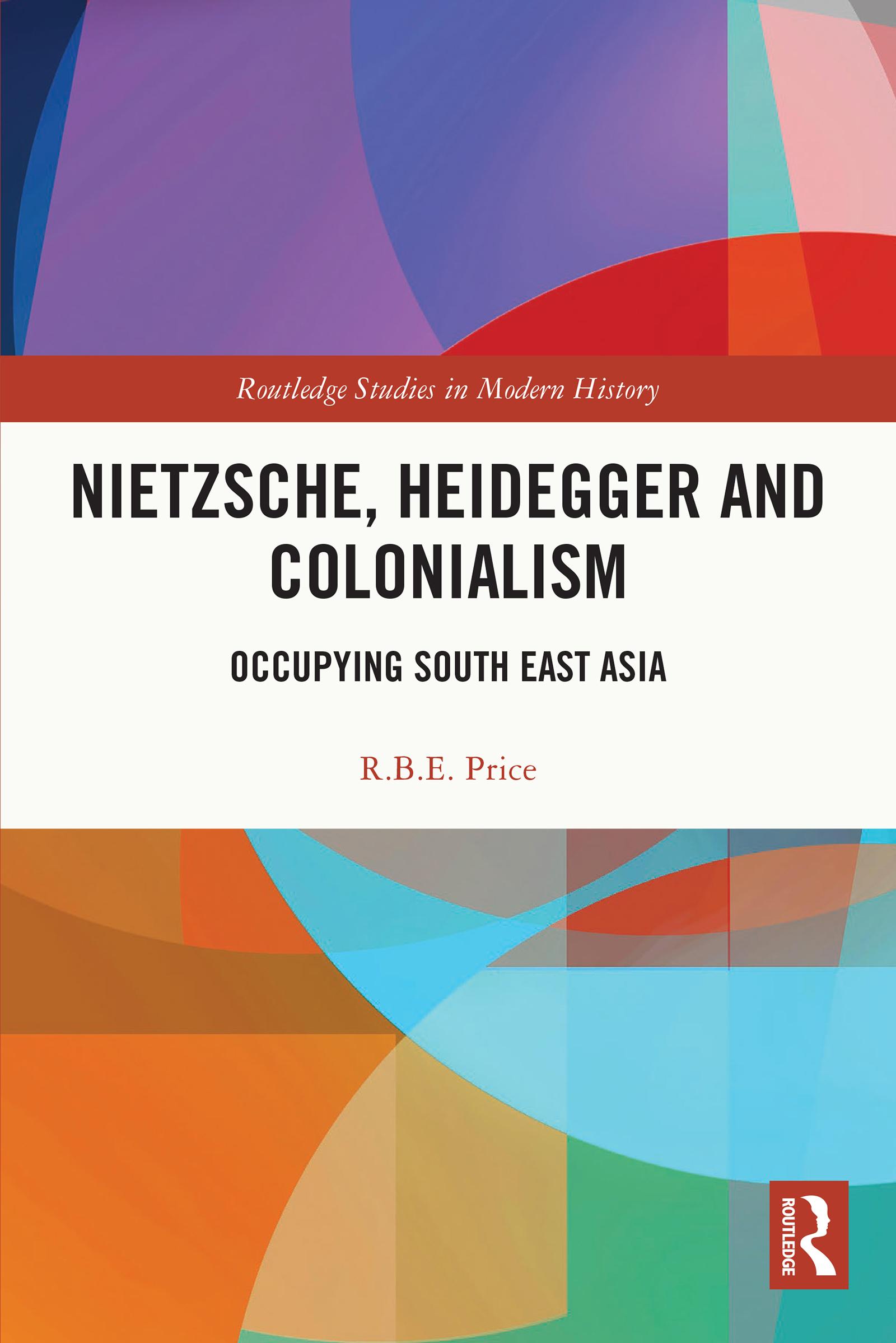
This text argues that Nietzsche’s idea of invalid policy that is believed to be valid and Heidegger’s concept of doubt as the reason for a representation are essentially the same idea. Using this insight, the text investigates vignettes from colonial occupation in Southeast Asia and its protest occupations to contend that untruth, covered in camouflages of constancy and morality, has been a powerful force in Asian history. The Nietzschean inflections applied here include Superhumanity, the eternal return of trauma, the critiques of morality, and the moralisation of guilt. Many ideas from the Heideggerian canon are used, including the struggle for individual validity amidst the debasement and imbalance of Being. Concepts such as thrownness, finitude and the remnant cultural power of Christianity, are also deployed in an exposé of colonial practices. The book gives detailed treatment to post-colonial Malaya (1963), Japanese occupied Hong Kong (1941–1945), and the tussle with communism in Cold War Singapore and Malaya, as well as the question of Kuomintang KMT validity in Hong Kong (1945–1949) and British Malaya (1950– 1953). The book explains the struggles for identity in the Hong Kong protest movement (2014–2020) by showing how economic distortion caused by landlordism has been covered by aspirations for freedom.
Pay easily by card, Klarna, Apple Pay or Google Pay. Not happy? You always have a 14-day money-back guarantee. Read more in our terms. If you have any questions, email us at hello@memmo.org.
Memmo makes studying easier – wherever you are in the world. We bring your course books and smart study tools together in one place: summaries, quizzes, podcasts and flashcards. Plus Ted, your study buddy who answers anything you wonder. Over 50,000 students already study here – built to help you learn faster and stress less.