
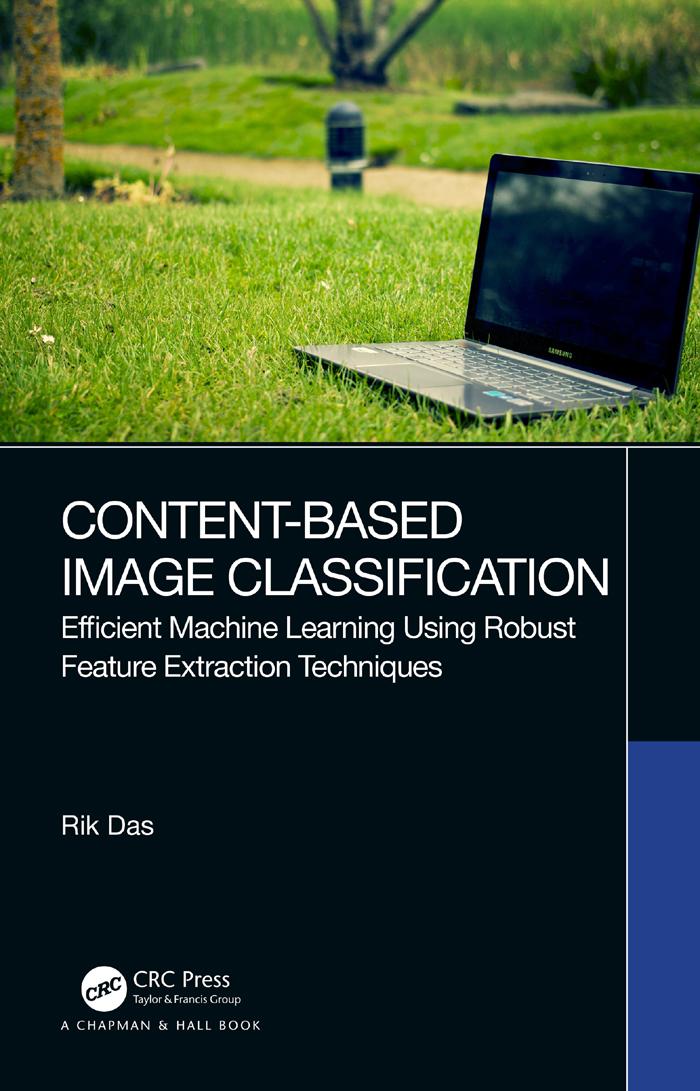
Content-Based Image Classification: Efficient Machine Learning Using Robust Feature Extraction Techniques is a comprehensive guide to research with invaluable image data. Social Science Research Network has revealed that 65% of people are visual learners. Research data provided by Hyerle (2000) has clearly shown 90% of information in the human brain is visual. Thus, it is no wonder that visual information processing in the brain is 60,000 times faster than text-based information (3M Corporation, 2001). Recently, we have witnessed a significant surge in conversing with images due to the popularity of social networking platforms. The other reason for embracing usage of image data is the mass availability of high-resolution cellphone cameras. Wide usage of image data in diversified application areas including medical science, media, sports, remote sensing, and so on, has spurred the need for further research in optimizing archival, maintenance, and retrieval of appropriate image content to leverage data-driven decision-making. This book demonstrates several techniques of image processing to represent image data in a desired format for information identification. It discusses the application of machine learning and deep learning for identifying and categorizing appropriate image data helpful in designing automated decision support systems.
The book offers comprehensive coverage of the most essential topics, including:
- Image feature extraction with novel handcrafted techniques (traditional feature extraction)
- Image feature extraction with automated techniques (representation learning with CNNs)
- Significance of fusion-based approaches in enhancing classification accuracy
- MATLAB® codes for implementing the techniques
- Use of the Open Access data mining tool WEKA for multiple tasks
The book is intended for budding researchers, technocrats, engineering students, and machine learning/deep learning enthusiasts who are willing to start their computer vision journey with content-based image recognition. The readers will get a clear picture of the essentials for transforming the image data into valuable means for insight generation. Readers will learn coding techniques necessary to propose novel mechanisms and disruptive approaches. The WEKA guide provided is beneficial for those uncomfortable coding for machine learning algorithms. The WEKA tool assists the learner in implementing machine learning algorithms with the click of a button. Thus, this book will be a stepping-stone for your machine learning journey.
Please visit the author's website for any further guidance at https://www.rikdas.com/
Pay easily by card, Klarna, Apple Pay or Google Pay. Not happy? You always have a 14-day money-back guarantee. Read more in our terms. If you have any questions, email us at hello@memmo.org.
Memmo makes studying easier – wherever you are in the world. We bring your course books and smart study tools together in one place: summaries, quizzes, podcasts and flashcards. Plus Ted, your study buddy who answers anything you wonder. Over 50,000 students already study here – built to help you learn faster and stress less.