
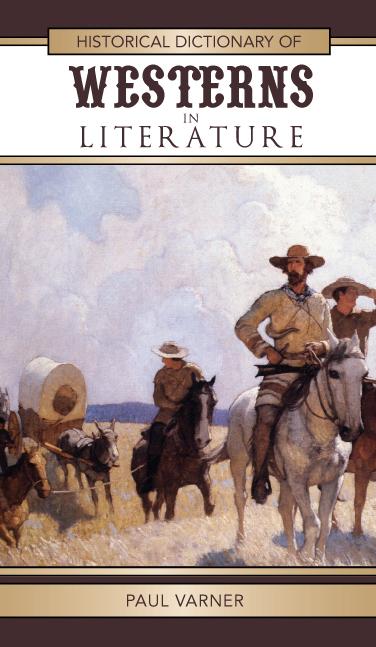
When in 1902 Owen Wister, a member of the Eastern blueblood aristocracy and friend of novelist Henry James, became a best-selling novelist with the publication of The Virginian, few readers would have guessed that a new kind of American literature was being born. While Owen Wister was enjoying his success, Edwin S. Porter in New Jersey was filming the first cinema Western The Great Train Robbery, which would usher in a new era both of movies in general and of Western movies in particular. Both events would lead to a century of cultural fascination with stories of the old West.
The Historical Dictionary of Westerns in Literature tells the story of the Western through a chronology, a bibliography, an introductory essay, and hundreds of cross-referenced dictionary entries on authors such as Owen Wister, Zane Grey, Max Brand, Clarence Mulford, Ernest Haycox, Luke Short, Dorothy Johnson, Louis L'Amour, and Cormac McCarthy.
The Historical Dictionary of Westerns in Literature tells the story of the Western through a chronology, a bibliography, an introductory essay, and hundreds of cross-referenced dictionary entries on authors such as Owen Wister, Zane Grey, Max Brand, Clarence Mulford, Ernest Haycox, Luke Short, Dorothy Johnson, Louis L'Amour, and Cormac McCarthy.
Pay easily by card, Klarna, Apple Pay or Google Pay. Not happy? You always have a 14-day money-back guarantee. Read more in our terms. If you have any questions, email us at hello@memmo.org.
Memmo makes studying easier – wherever you are in the world. We bring your course books and smart study tools together in one place: summaries, quizzes, podcasts and flashcards. Plus Ted, your study buddy who answers anything you wonder. Over 50,000 students already study here – built to help you learn faster and stress less.