
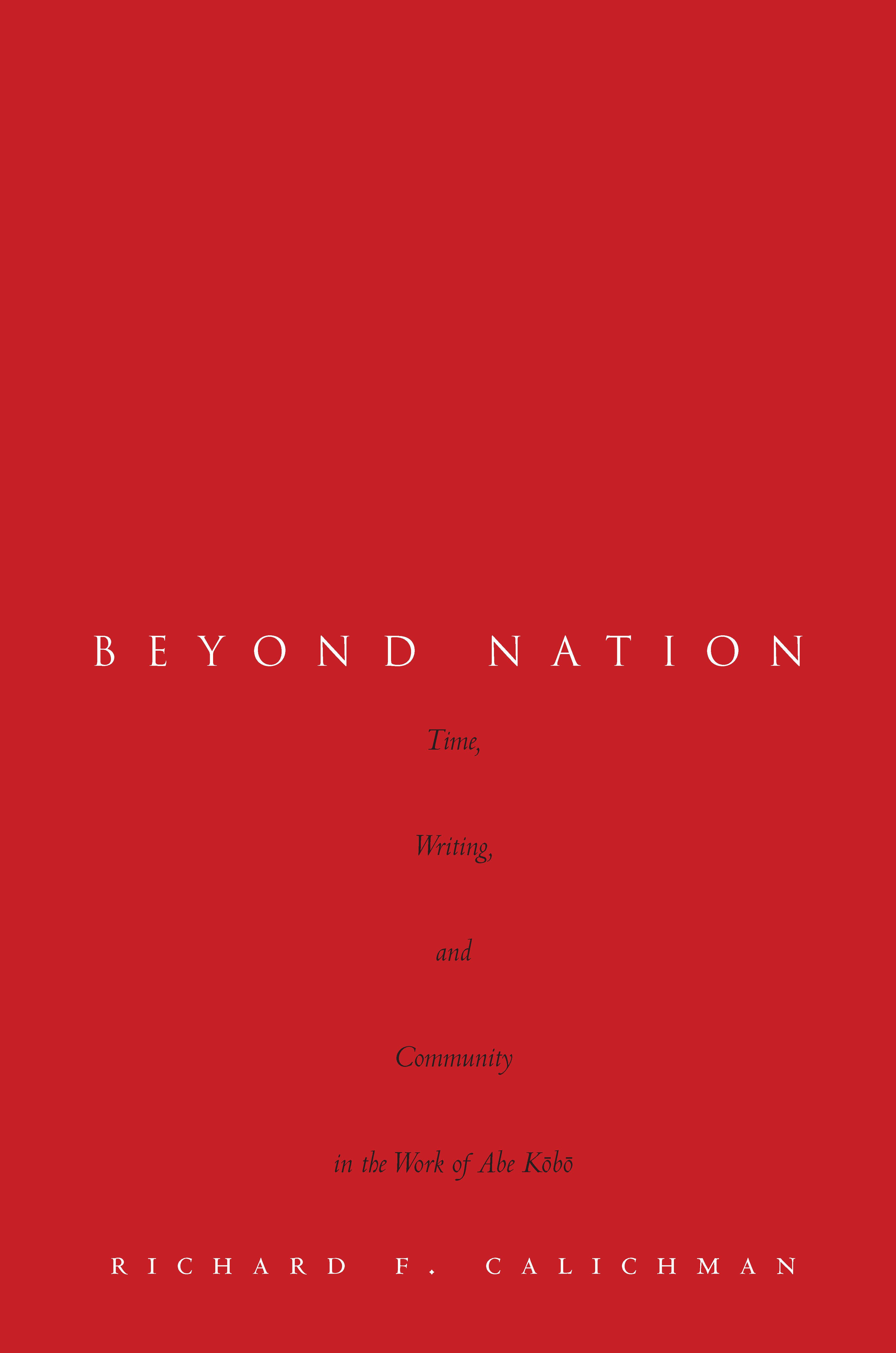
In the work of writer Abe Kōbō (1924–1993), characters are alienated both from themselves and from one another. Through close readings of Abe's work, Richard Calichman reveals how time and writing have the ability to unground identity. Over time, attempts to create unity of self cause alienation, despite government attempts to convince people to form communities (and nations) to recapture a sense of wholeness. Art, then, must resist the nation-state and expose its false ideologies.
Calichman argues that Abe's attack on the concept of national affiliation has been neglected through his inscription as a writer of Japanese literature. At the same time, the institution of Japan Studies works to tighten the bond between nation-state and individual subject. Through Abe's essays and short stories, he shows how the formation of community is constantly displaced by the notions of time and writing. Beyond Nation thus analyzes the elements of Orientalism, culturalism, and racism that often underlie the appeal to collective Japanese identity.
Pay easily by card, Klarna, Apple Pay or Google Pay. Not happy? You always have a 14-day money-back guarantee. Read more in our terms. If you have any questions, email us at hello@memmo.org.
Memmo makes studying easier – wherever you are in the world. We bring your course books and smart study tools together in one place: summaries, quizzes, podcasts and flashcards. Plus Ted, your study buddy who answers anything you wonder. Over 50,000 students already study here – built to help you learn faster and stress less.