
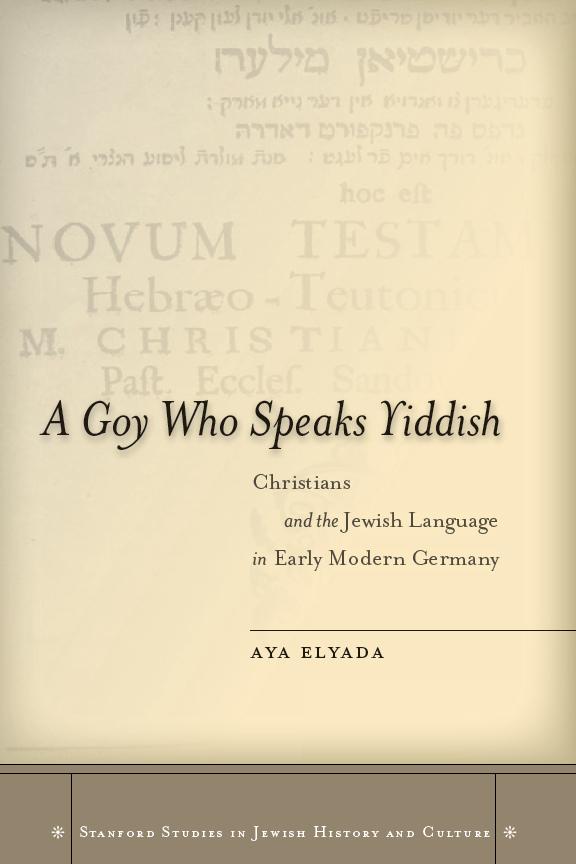
This book explores the unique phenomenon of Christian engagement with Yiddish language and literature from the beginning of the sixteenth century to the late eighteenth century. By exploring the motivations for Christian interest in Yiddish, and the differing ways in which Yiddish was discussed and treated in Christian texts, A Goy Who Speaks Yiddish addresses a wide array of issues, most notably Christian Hebraism, Protestant theology, early modern Yiddish culture, and the social and cultural history of language in early modern Europe.
Elyada's analysis of a wide range of philological and theological works, as well as textbooks, dictionaries, ethnographical writings, and translations, demonstrates that Christian Yiddishism had implications beyond its purely linguistic and philological dimensions. Indeed, Christian texts on Yiddish reveal not only the ways in which Christians perceived and defined Jews and Judaism, but also, in a contrasting vein, how they viewed their own language, religion, and culture.
Pay easily by card, Klarna, Apple Pay or Google Pay. Not happy? You always have a 14-day money-back guarantee. Read more in our terms. If you have any questions, email us at hello@memmo.org.
Memmo makes studying easier – wherever you are in the world. We bring your course books and smart study tools together in one place: summaries, quizzes, podcasts and flashcards. Plus Ted, your study buddy who answers anything you wonder. Over 50,000 students already study here – built to help you learn faster and stress less.