
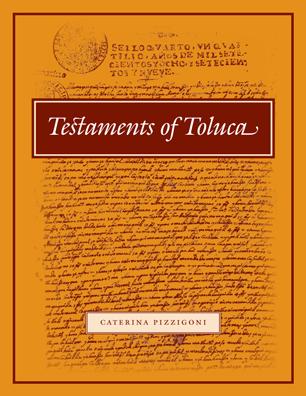
Testaments written in their own language, Nahuatl, have been crucial for reconstructing the everyday life of the indigenous people of central Mexico after Spanish contact. Those published to date have largely been from the sixteenth and early seventeenth centuries. Testaments of Toluca presents a large body of Nahuatl wills (98) from 1652 to 1783 from an important valley not much studied, thus greatly enlarging our perspective on the evolution of indigenous society and culture in central Mexico. Each testament is transcribed, translated, and accompanied by a commentary on the testator's situation and on interesting terminology. A substantial introductory study fully analyzes the testamentary genre as seen in this corpus (a first) and summarizes the content of the documents in realms such as gender, kinship, household, and land. Wills are very human documents, and the apparatus draws out this aspect, telling us much of local indigenous life in central Mexico in the third century after Spanish contact, so that the book is of potential interest to a broad spectrum of readers.
Pay easily by card, Klarna, Apple Pay or Google Pay. Not happy? You always have a 14-day money-back guarantee. Read more in our terms. If you have any questions, email us at hello@memmo.org.
Memmo makes studying easier – wherever you are in the world. We bring your course books and smart study tools together in one place: summaries, quizzes, podcasts and flashcards. Plus Ted, your study buddy who answers anything you wonder. Over 50,000 students already study here – built to help you learn faster and stress less.