
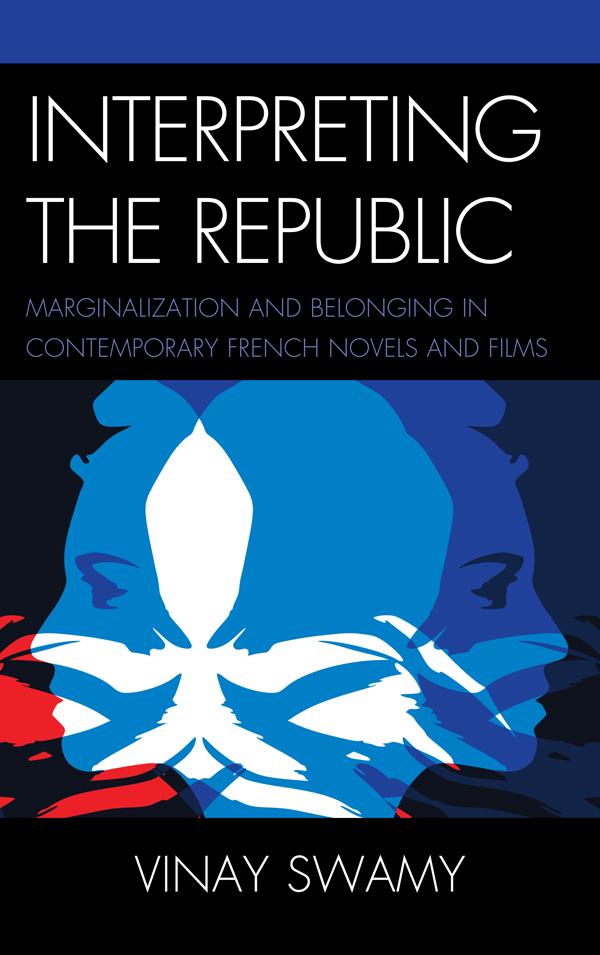
Interpreting the Republic focuses on contemporary French literary and cinematic works (1986-2003) that reflect on what it means to belong to a nation such as France by giving voice to those who find themselves marginalized by French society. While citizenship and belonging can be, and indeed are, interpreted differently depending on the socio-cultural and political context, it is the foundational universalist republican principle of egalitarianism that has remained the sacred cow of French society. One of the major claims of this study is that the rigidity of French national discourse that attempts to impose a certain homogeneity in its official identificatory practices—all citizens are French, and thus difference (ethnic, sexual or other) ceases to matter—is but one of the many possible interpretations of the notion of the Republic. Vinay Swamy seeks to show how such supposedly unshakeable principles, too, can be, and often are, reinterpreted in novel ways by the works analyzed in this study, which carve out niches for their protagonists that are otherwise foreclosed in the French national space.
Swamy examines the different tactics of identification deployed in works ranging from early "romans beurs" by Azouz Begag, Farida Belghoul and Soraya Nini, and Allah Superstar, the 2003 satirical novel by Y.B., to a number of films including Gazon maudit (1995), Ma vie en rose (1997), Le Placard (2001), Chouchou (2003), all of which (re)interpret the Republic in an effort to legitimize their protagonists' otherwise marginalized social position(s). He demonstrates how all these works put pressure, in a variety of ways, on an unacknowledged understanding of the institutional positions.
Swamy examines the different tactics of identification deployed in works ranging from early "romans beurs" by Azouz Begag, Farida Belghoul and Soraya Nini, and Allah Superstar, the 2003 satirical novel by Y.B., to a number of films including Gazon maudit (1995), Ma vie en rose (1997), Le Placard (2001), Chouchou (2003), all of which (re)interpret the Republic in an effort to legitimize their protagonists' otherwise marginalized social position(s). He demonstrates how all these works put pressure, in a variety of ways, on an unacknowledged understanding of the institutional positions.
Pay easily by card, Klarna, Apple Pay or Google Pay. Not happy? You always have a 14-day money-back guarantee. Read more in our terms. If you have any questions, email us at hello@memmo.org.
Memmo makes studying easier – wherever you are in the world. We bring your course books and smart study tools together in one place: summaries, quizzes, podcasts and flashcards. Plus Ted, your study buddy who answers anything you wonder. Over 50,000 students already study here – built to help you learn faster and stress less.