
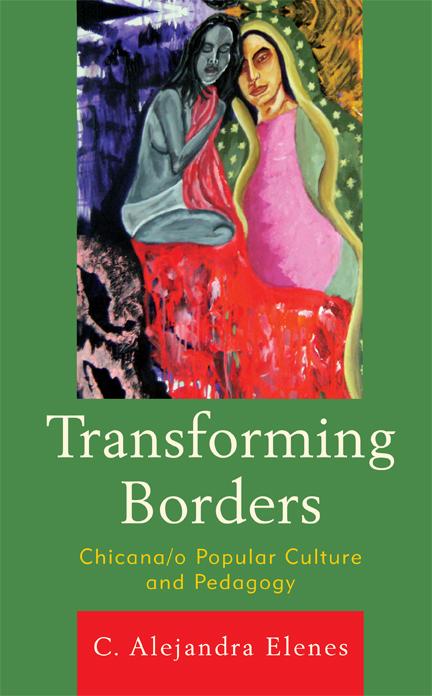
Transforming Borders: Chicana/o Popular Culture and Pedagogy contributes to transformative pedagogies scholarship by adding the voices of Chicana feminist pedagogies, epistemologies, and ontologies. C. Alejandra Elenes develops her conceptualizations of border/transformative pedagogies by linking the relationship between cultural practices, knowledge, and teaching in everyday life. She analyzes Chicana feminist cultural workers/educational actors re-imagining three Mexican figures: La Llorona (the weeping woman), the Virgen of Guadalupe, and Malintzin/Malinche as epistemological and pedagogical meanings. The three figures represent multiple meanings: traditional views on femininity, religion, and nationalist views on women, yet at the same time, feminists have re-imagined these three figures and developed counter-narratives that can offer alternatives to the traditional meanings.
In developing border/transformative pedagogies, Elenes looks at the significance of historical events, such as the creation of the Mexico-U.S. border, to understand the experiences of people of Mexican descent in the United States. She also examines oral histories of the legend of La Llorona in the Southwest, historical documents on the Spanish conquest of Mexico, and Chicana artists such as Ester Hernandez, Yolanda Lopez, Consuelo Jimenez Underwood, and Alma Lopez re-imagining of the Virgen of Guadalupe. The conflicts over the meanings of the three figures can help us understand how Chicanas have used their voices to counter economic and gender inequalities and how pedagogical practices show that cultural productions are sites where forms of domination can be contested and recreated in ways that allow for the creation of alternative identities and subjectivities.
In developing border/transformative pedagogies, Elenes looks at the significance of historical events, such as the creation of the Mexico-U.S. border, to understand the experiences of people of Mexican descent in the United States. She also examines oral histories of the legend of La Llorona in the Southwest, historical documents on the Spanish conquest of Mexico, and Chicana artists such as Ester Hernandez, Yolanda Lopez, Consuelo Jimenez Underwood, and Alma Lopez re-imagining of the Virgen of Guadalupe. The conflicts over the meanings of the three figures can help us understand how Chicanas have used their voices to counter economic and gender inequalities and how pedagogical practices show that cultural productions are sites where forms of domination can be contested and recreated in ways that allow for the creation of alternative identities and subjectivities.
Pages: 240
Category: Kultur-, Genus- & Postkoloniala studier
e-ISBN: 9780739147818
Shipping weight: 1.2 kg
Ships in: 1-2 days
Pay easily by card, Klarna, Apple Pay or Google Pay. Not happy? You always have a 14-day money-back guarantee. Read more in our terms. If you have any questions, email us at hello@memmo.org.
Memmo makes studying easier – wherever you are in the world. We bring your course books and smart study tools together in one place: summaries, quizzes, podcasts and flashcards. Plus Ted, your study buddy who answers anything you wonder. Over 50,000 students already study here – built to help you learn faster and stress less.