
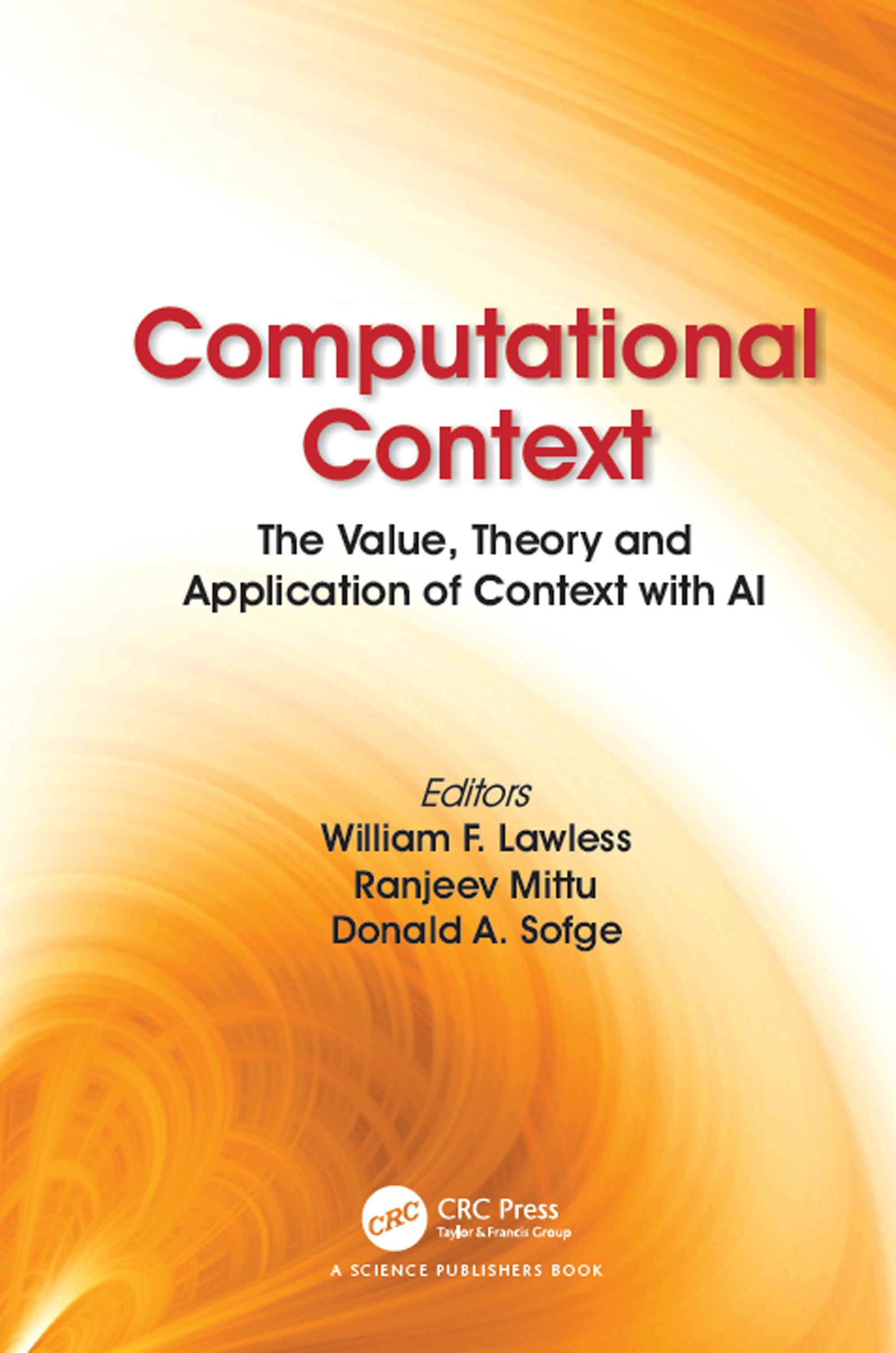
This volume addresses context from three comprehensive perspectives: first, its importance, the issues surrounding context, and its value in the laboratory and the field; second, the theory guiding the AI used to model its context; and third, its applications in the field (e.g., decision-making). This breadth poses a challenge. The book analyzes how the environment (context) influences human perception, cognition and action. While current books approach context narrowly, the major contribution of this book is to provide an in-depth review over a broad range of topics for a computational context no matter its breadth. The volume outlines numerous strategies and techniques from world-class scientists who have adapted their research to solve different problems with AI, in difficult environments and complex domains to address the many computational challenges posed by context.
Context can be clear, uncertain or an illusion. Clear contexts: A father praising his child; a trip to the post office to buy stamps; a policewoman asking for identification. Uncertain contexts: A sneak attack; a surprise witness in a courtroom; a shout of "Fire! Fire!" Contexts as illusion: Humans fall prey to illusions that machines do not (Adelson’s checkerboard illusion versus a photometer). Determining context is not easy when disagreement exists, interpretations vary, or uncertainty reigns. Physicists like Einstein (relativity), Bekenstein (holographs) and Rovelli (universe) have written that reality is not what we commonly believe. Even outside of awareness, individuals act differently whether alone or in teams.
Can computational context with AI adapt to clear and uncertain contexts, to change over time, and to individuals, machines or robots as well as to teams? If a program automatically "knows" the context that improves performance or decisions, does it matter whether context is clear, uncertain or illusory? Written and edited by world class leaders from across the field of autonomous systems research, this volume carefully considers the computational systems being constructed to determine context for individual agents or teams, the challenges they face, and the advances they expect for the science of context.
Pay easily by card, Klarna, Apple Pay or Google Pay. Not happy? You always have a 14-day money-back guarantee. Read more in our terms. If you have any questions, email us at hello@memmo.org.
Memmo makes studying easier – wherever you are in the world. We bring your course books and smart study tools together in one place: summaries, quizzes, podcasts and flashcards. Plus Ted, your study buddy who answers anything you wonder. Over 50,000 students already study here – built to help you learn faster and stress less.