
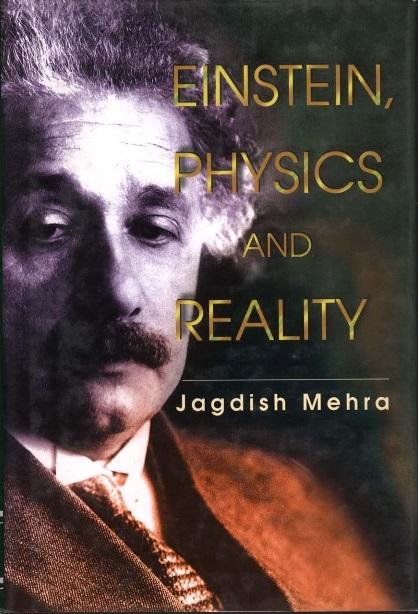
Albert Einstein was one of the principal founders of the quantum and relativity theories. Until 1925, when the Bose-Einstein statistics was discovered, he made great contributions to the foundations of quantum theory. However, after the discovery of quantum mechanics by Heisenberg and wave mechanics by Schrödinger, with the consequent development of the principles of uncertainty and complementarity, it would seem that Einstein's views completely changed. In his theory of the Brownian motion, Einstein had invoked the theory of probability to establish the reality of atoms and molecules; but, in 1916-17, when he wished to predict the exact instant when an atom would radiate — and developed his theory of the A and B coefficients — he wondered whether the “quantum absorption and emission of light could ever be understood in the sense of the complete causality requirement, or would a statistical residue remain? I must admit that there I lack the courage of my convictions. But I would be very unhappy to renounce complete causality”, as he wrote to his friend Max Born. However, he wrote later to Born that quantum mechanics “is certainly imposing”, but “an inner voice tells me that it is not the real thing … It does not bring us closer to the secret of the ‘Old One’. I, at any rate, am convinced that He is not playing at dice”. At the 1927 and 1930 Solvay Conferences on Physics in Brussels, Einstein engaged in profound discussions with Niels Bohr and others about his conviction regarding classical determinism versus the statistical causality of quantum mechanics. To the end of his life he retained his belief in a deterministic philosophy. This highly interesting book explores Einstein's views on the nature and structure of physics and reality.
Płać wygodnie kartą, Klarną, Apple Pay lub Google Pay. Nie jesteś zadowolony? Zawsze masz 14-dniową gwarancję zwrotu pieniędzy. Więcej przeczytasz w naszych warunkach. Masz pytania? Napisz do nas na hello@memmo.org.
Memmo ułatwia naukę – gdziekolwiek jesteś na świecie. U nas znajdziesz podręczniki i sprytne narzędzia do nauki w jednym miejscu: streszczenia, quizy, podcasty i fiszki. A do tego Ted, Twój kumpel do nauki, który odpowie na wszystko, co Cię nurtuje. Ponad 50 000 studentów już tu się uczy – stworzone, byś uczył się szybciej i mniej stresował.
Może Ci się spodobać
Kup książkę0