
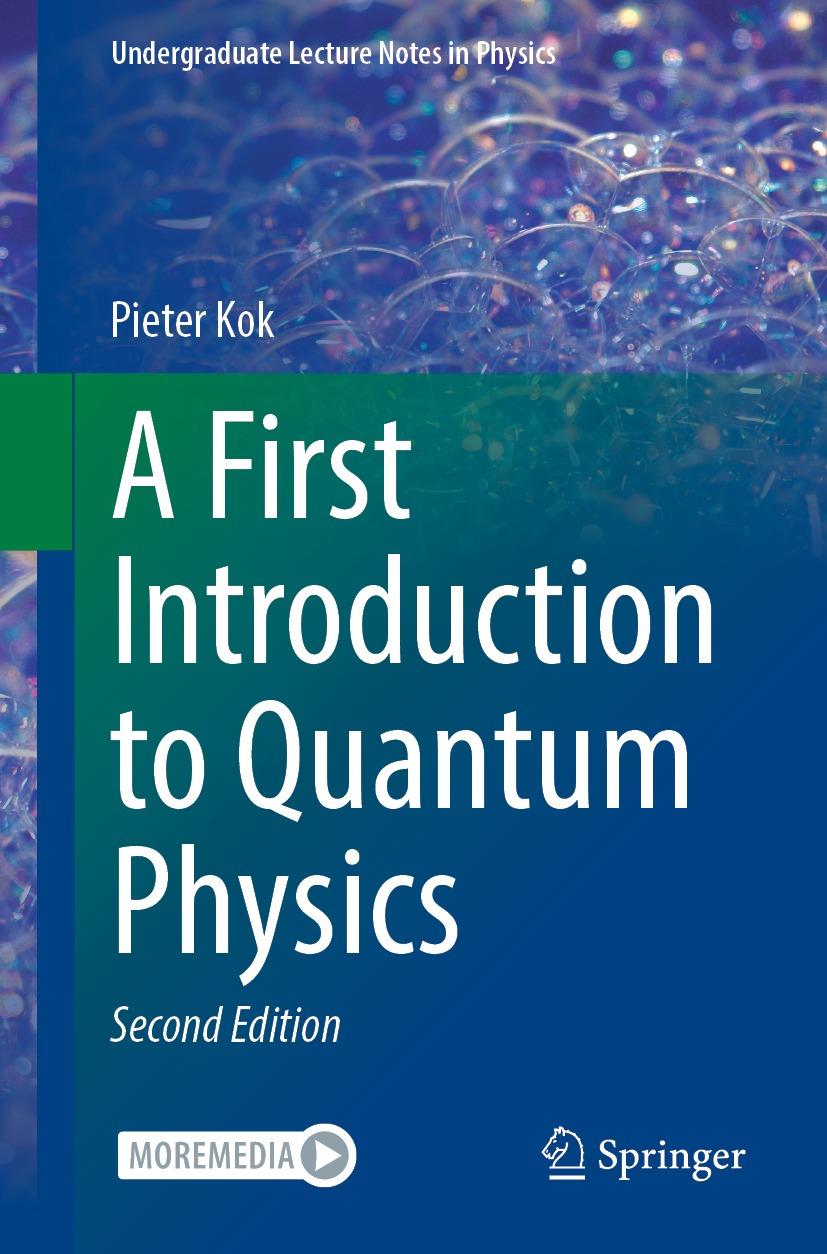
In this undergraduate textbook, now in its 2nd edition, the author develops the quantum theory from first principles based on very simple experiments: a photon traveling through beam splitters to detectors, an electron moving through magnetic fields, and an atom emitting radiation. From the physical description of these experiments follows a natural mathematical description in terms of matrices and complex numbers.
The first part of the book examines how experimental facts force us to let go of some deeply held preconceptions and develops this idea into a description of states, probabilities, observables, and time evolution. The quantum mechanical principles are illustrated using applications such as gravitational wave detection, magnetic resonance imaging, atomic clocks, scanning tunneling microscopy, and many more. The first part concludes with an overview of the complete quantum theory.
The second part of the book covers more advanced topics, including the concept ofentanglement, the process of decoherence or how quantum systems become classical, quantum computing and quantum communication, and quantum particles moving in space. Here, the book makes contact with more traditional approaches to quantum physics. The remaining chapters delve deeply into the idea of uncertainty relations and explore what the quantum theory says about the nature of reality.
The book is an ideal accessible introduction to quantum physics, tested in the classroom, with modern examples and plenty of end-of-chapter exercises.
Płać wygodnie kartą, Klarną, Apple Pay lub Google Pay. Nie jesteś zadowolony? Zawsze masz 14-dniową gwarancję zwrotu pieniędzy. Więcej przeczytasz w naszych warunkach. Masz pytania? Napisz do nas na hello@memmo.org.
Memmo ułatwia naukę – gdziekolwiek jesteś na świecie. U nas znajdziesz podręczniki i sprytne narzędzia do nauki w jednym miejscu: streszczenia, quizy, podcasty i fiszki. A do tego Ted, Twój kumpel do nauki, który odpowie na wszystko, co Cię nurtuje. Ponad 50 000 studentów już tu się uczy – stworzone, byś uczył się szybciej i mniej stresował.