
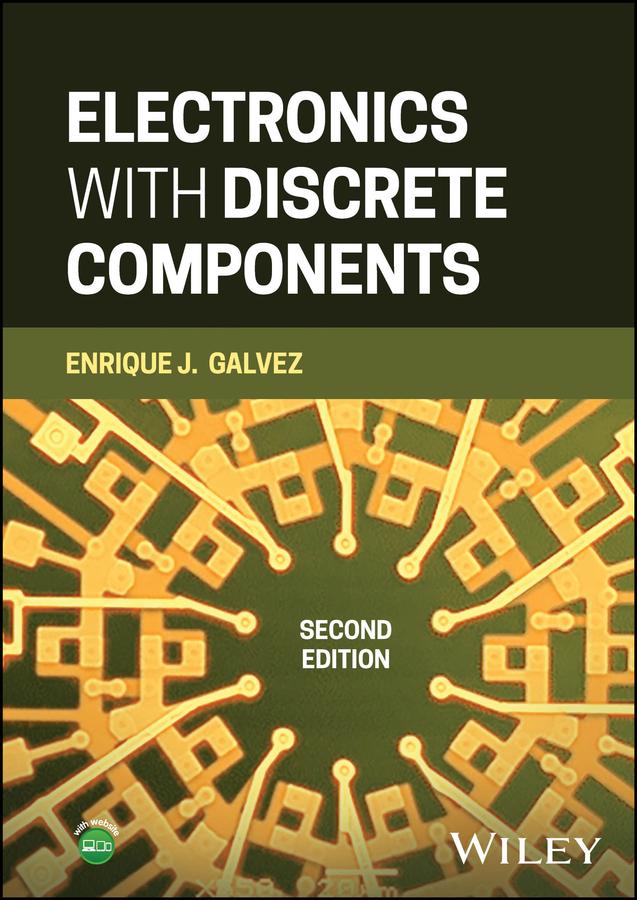
Comprehensive textbook on electronics for physicists, now with more examples, exercises, hands-on electronics labs, troubleshooting tips, and practical exercises
Electronics with Discrete Components delivers a comprehensive overview of electronics from the perspective of a physicist. In the first part on digital components, after an introduction to digital electronics, the text covers fundamentals of combinational logic and its implementation in combinational logic devices, followed by sequential-logic devices such as flip-flops and memory components. The second part on analog components deals with the fundamentals of signal processing, filters, components such as diodes and transistors, and a lengthy coverage of operational amplifiers.
Each chapter ends with problem sets and “lab projects” that have been proven to work well for instruction. Questions on simple aspects of the lab that students should know are also included, such as regarding powering components and diagnosing signals with the oscilloscope and providing “troubleshooting tips” to help students find out why a particular circuit does not work.
The new edition of this textbook adds more worked examples, exercises with answers for the self-learner, and end-of-chapter problems. It adds new electronic components, covers the latest digital technologies plus adds a new section of Fourier transforms in electronics. In addition, it features labs with Arduino or Teensy boards which have become widespread in the community as inexpensive, easy-to-use electronics platforms.
Electronics with Discrete Components includes information on:
- Number systems, codes, signed numbers, binary functions, logic families, and IC wirings
- Filters and the frequency domain, covering RC, high- and low-pass, and cascading filters, FFTs, as well as important considerations for filter design
- Connecting digital to analog and to the world through TTL, CMOS, and LV gates and interfacing between the logic families
- Charge and potential, capacitors, electrical current, resistors, magnetic components, power, circuits, and abstractions and symbol jargon in the field
The Second Edition of Electronics with Discrete Components is an ideal textbook resource for a one-semester course on electronics for second-year physics students, as well as students from other disciplines or levels who understand elementary notions of circuits and complex numbers.
Płać wygodnie kartą, Klarną, Apple Pay lub Google Pay. Nie jesteś zadowolony? Zawsze masz 14-dniową gwarancję zwrotu pieniędzy. Więcej przeczytasz w naszych warunkach. Masz pytania? Napisz do nas na hello@memmo.org.
Memmo ułatwia naukę – gdziekolwiek jesteś na świecie. U nas znajdziesz podręczniki i sprytne narzędzia do nauki w jednym miejscu: streszczenia, quizy, podcasty i fiszki. A do tego Ted, Twój kumpel do nauki, który odpowie na wszystko, co Cię nurtuje. Ponad 50 000 studentów już tu się uczy – stworzone, byś uczył się szybciej i mniej stresował.