
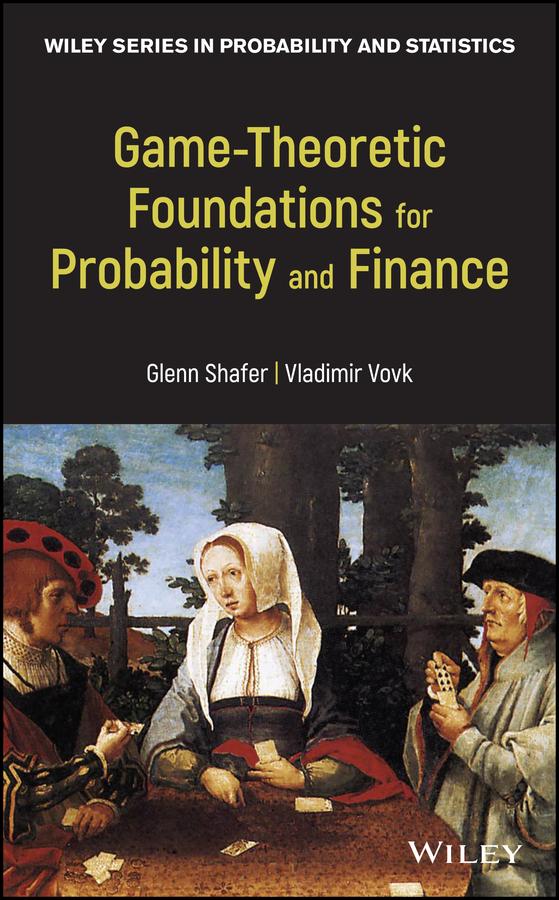
Game-theoretic probability and finance come of age
Glenn Shafer and Vladimir Vovk’s Probability and Finance, published in 2001, showed that perfect-information games can be used to define mathematical probability. Based on fifteen years of further research, Game-Theoretic Foundations for Probability and Finance presents a mature view of the foundational role game theory can play. Its account of probability theory opens the way to new methods of prediction and testing and makes many statistical methods more transparent and widely usable. Its contributions to finance theory include purely game-theoretic accounts of Ito’s stochastic calculus, the capital asset pricing model, the equity premium, and portfolio theory.
Game-Theoretic Foundations for Probability and Finance is a book of research. It is also a teaching resource. Each chapter is supplemented with carefully designed exercises and notes relating the new theory to its historical context.
Praise from early readers
“Ever since Kolmogorov's Grundbegriffe, the standard mathematical treatment of probability theory has been measure-theoretic. In this ground-breaking work, Shafer and Vovk give a game-theoretic foundation instead. While being just as rigorous, the game-theoretic approach allows for vast and useful generalizations of classical measure-theoretic results, while also giving rise to new, radical ideas for prediction, statistics and mathematical finance without stochastic assumptions. The authors set out their theory in great detail, resulting in what is definitely one of the most important books on the foundations of probability to have appeared in the last few decades.” – Peter Grünwald, CWI and University of Leiden
“Shafer and Vovk have thoroughly re-written their 2001 book on the game-theoretic foundations for probability and for finance. They have included an account of the tremendous growth that has occurred since, in the game-theoretic and pathwise approaches to stochastic analysis and in their applications to continuous-time finance. This new book will undoubtedly spur a better understanding of the foundations of these very important fields, and we should all be grateful to its authors.” – Ioannis Karatzas, Columbia University
Płać wygodnie kartą, Klarną, Apple Pay lub Google Pay. Nie jesteś zadowolony? Zawsze masz 14-dniową gwarancję zwrotu pieniędzy. Więcej przeczytasz w naszych warunkach. Masz pytania? Napisz do nas na hello@memmo.org.
Memmo ułatwia naukę – gdziekolwiek jesteś na świecie. U nas znajdziesz podręczniki i sprytne narzędzia do nauki w jednym miejscu: streszczenia, quizy, podcasty i fiszki. A do tego Ted, Twój kumpel do nauki, który odpowie na wszystko, co Cię nurtuje. Ponad 50 000 studentów już tu się uczy – stworzone, byś uczył się szybciej i mniej stresował.