
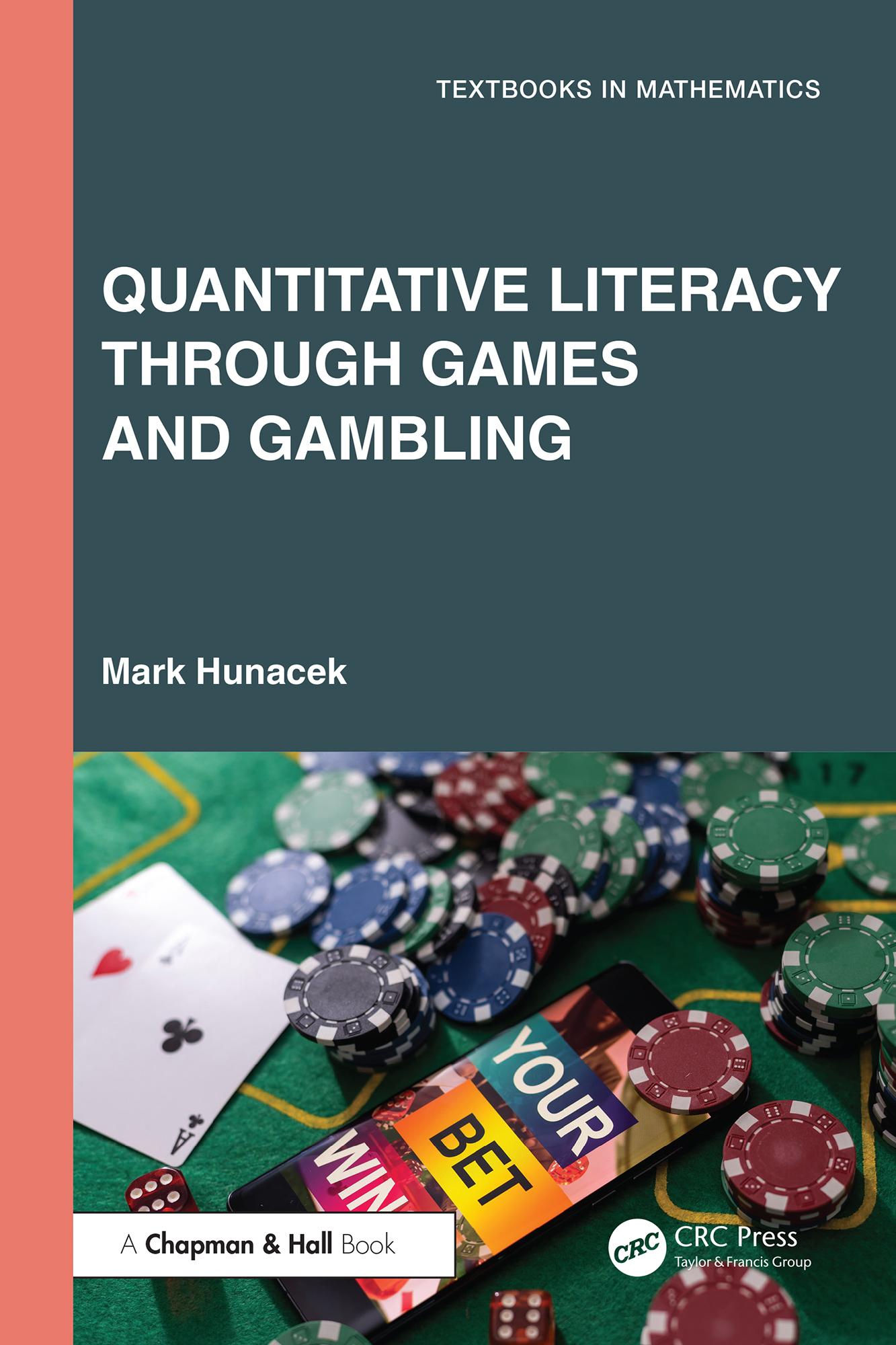
This book was developed to address a need. Quantitative Literacy courses have been established in the mathematics curriculum for decades now. The students in these courses typically dislike and fear mathematics, and the result is often a class populated by many students who are unmotivated and uninterested in the material.
This book is a text for such a course; however, it is focused on a single idea that most students seem to already have some intrinsic interest in and is written at an accessible level. It covers the basic ideas of discrete probability and shows how these ideas can be applied to familiar games (roulette, poker, blackjack, etc.). The gambling material is interweaved through the book and introduced as soon as the necessary mathematics has been developed. Throughout, mathematical formalism and symbolism have been avoided, and numerous examples are provided.
The book starts with a simple definition of probability, goes through some basic concepts like combining events and expected value, and then discusses some elementary mathematical aspects of various games. Roulette is introduced very early on, as is the game of craps, which requires some knowledge of conditional probability. Other games like poker, blackjack, and lotteries, whose study requires some rudimentary combinatorics, come shortly thereafter. The book ends with a brief introduction to zero-sum games, with some attention paid to the use of these ideas in studying bluffing.
In addition to discussion of these traditional games, the author motivates probability by talking about a few applications in legal proceedings that illustrate how mathematics has been misused in the courtroom. There is also a discussion of the Monty Hall problem, a nonintuitive result in probability that has an interesting and colorful history.
Hopefully, students studying from this text will find that mathematics is not as horrible as they have always thought and offers some interesting applications in the real world. This should perhaps be the goal of any quantitative literacy course.
Płać wygodnie kartą, Klarną, Apple Pay lub Google Pay. Nie jesteś zadowolony? Zawsze masz 14-dniową gwarancję zwrotu pieniędzy. Więcej przeczytasz w naszych warunkach. Masz pytania? Napisz do nas na hello@memmo.org.
Memmo ułatwia naukę – gdziekolwiek jesteś na świecie. U nas znajdziesz podręczniki i sprytne narzędzia do nauki w jednym miejscu: streszczenia, quizy, podcasty i fiszki. A do tego Ted, Twój kumpel do nauki, który odpowie na wszystko, co Cię nurtuje. Ponad 50 000 studentów już tu się uczy – stworzone, byś uczył się szybciej i mniej stresował.