
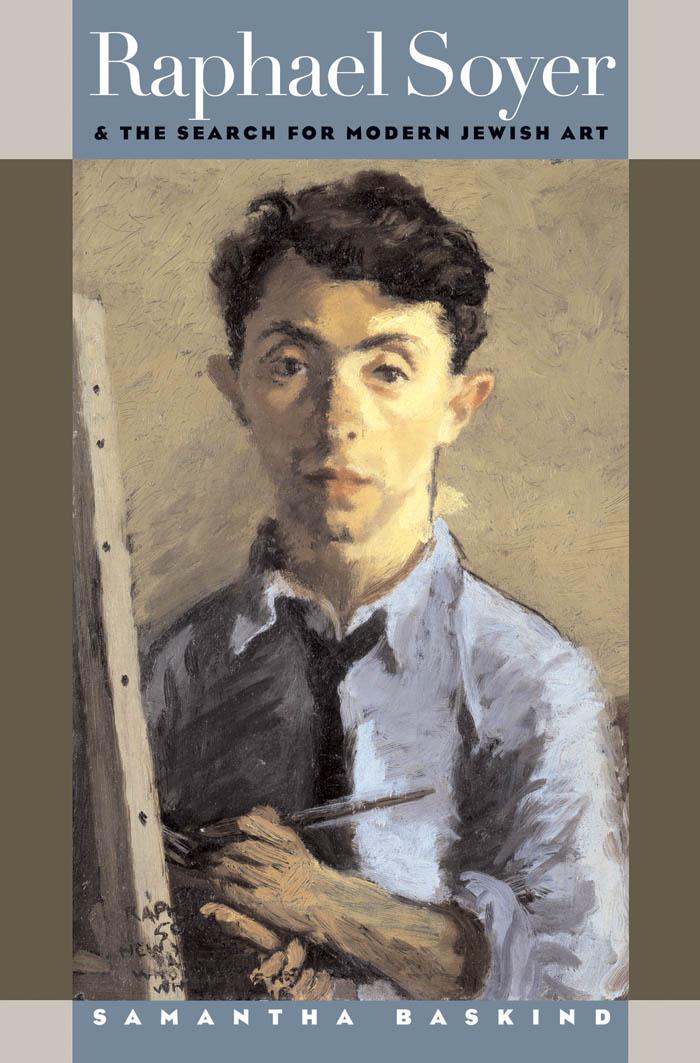
Artist Raphael Soyer (1899–1987), whose Russian Jewish family settled in Manhattan in 1912, was devoted to painting people in their everyday urban lives. He came to be known especially for his representations of city workers and the down-and-out, and for his portraits of himself and his friends. Although Soyer never identified himself as a “Jewish artist,” Samantha Baskind, in the first full-length critical study of the artist, argues that his work was greatly influenced by his ethnicity and by the Jewish American immigrant experience.
Baskind examines the painter’s art and life in the rich context of religious, cultural, political, and social conditions in the twentieth-century United States. By promoting an understanding of Soyer as a Jewish American artist, she addresses larger questions about the definition and study of modern Jewish art. Whereas previous scholars have defined Jewish art simply as art produced by people who were born Jewish, Baskind stresses the importance of an artist’s cultural identity when defining ethnic art. As Baskind explains how Soyer negotiated his Jewish identity in changing ways over his lifetime, she offers new strategies for identifying and interpreting Jewish art in general. Her analysis of Soyer’s work places the artist in a necessary context and provides a valuable new approach to the study of modern Jewish art.
Betal enkelt med kort, Klarna, Apple Pay eller Google Pay. Ikke fornøyd? Du har alltid 14 dagers angrerett. Les mer i våre vilkår. Har du spørsmål, send oss en e-post på hello@memmo.org.
Memmo gjør det enklere å studere – uansett hvor du er i verden. Hos oss samler du pensumbøker og smarte studieverktøy på ett og samme sted: sammendrag, quizer, podkaster og flashcards. Og så Ted, din studiekompis som svarer på alt du lurer på. Over 50 000 studenter studerer allerede her – bygget for at du skal lære raskere og stresse mindre.