
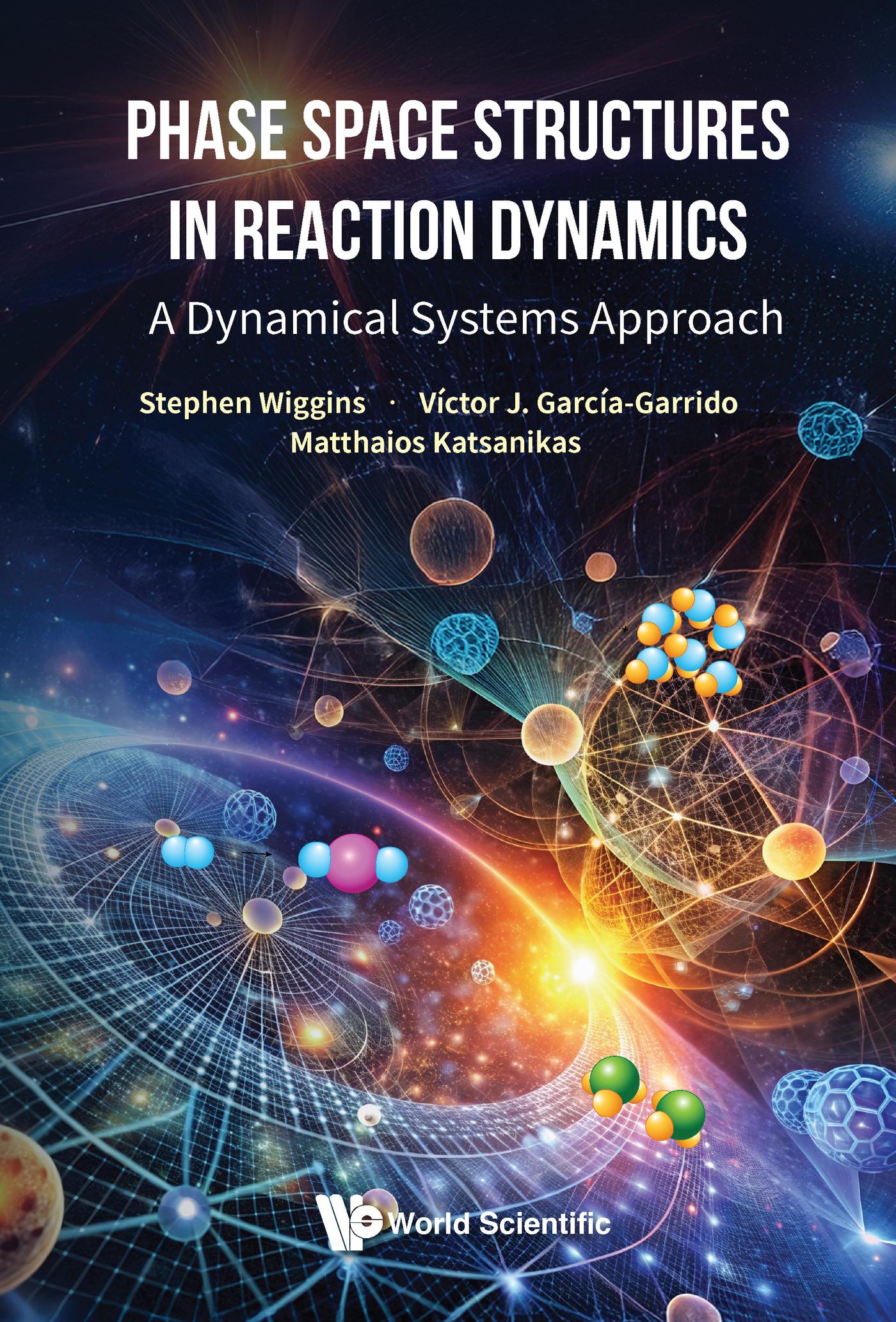
Chemical reaction dynamics is crucial for the study of chemical processes and the mechanisms which govern them. Most frameworks, however, remain static when representing the landscape of chemical reactions, falling short of capturing fully the evolution over time of the reaction profile.
This book presents an application of fundamental mathematical theories — dynamical systems theory and phase space — to chemical reaction dynamics. These concepts are relevant to the analysis of chemical transformations which always involve change over time. Exploiting the real-time evolution of molecular systems will enable better understanding and prediction of reaction characteristics, including reaction rates and product distributions. Traditional methods to quantify reactions rates do not always capture this complex snapshot from reactants to products.
In this book, the study of potential energy surfaces (PES) and other configurational landscapes is combined with phase space and dynamical systems theory, especially using the predictive value of the Hamiltonian. Introductory chapters focus on Hamiltonian dynamical systems and the crucial concepts in phase space and reaction dynamics, such as invariant manifolds, reactive islands and transition state theory. They are followed by examples with various degrees of freedom in numerous models, such as the Morse oscillator, the De Leon-Berne Isomerization Model, and the Caldera Model. Advanced examples are also included for higher-dimensional systems.
With the aim of bridging the gap between traditional static models and a more comprehensive, dynamic perspective, this book introduces dynamical systems theory in a more accessible and unified language. It should be relevant for applied mathematicians as well as computational chemists interested in chemical reaction dynamics.
Contents:
- Introduction and Background
- An Introduction to Hamiltonian Systems
- The Method of Lagrangian Descriptors
- Normally Hyperbolic Invariant Manifolds
- The Lyapunov Subcenter Theorem
- Reactive Islands
- Transition State Theory
- Construction of Phase Space Dividing Surfaces
- Fundamental Models Systems with 1 Degree-of-Freedom:
- The Morse Oscillator
- The Eckart Potential
- The De Leon-Berne Isomerization Model
- The Saddle-Node Hamiltonian
- The Caldera Model
- The Four-Well Potential
- The Valley-Ridge Inflection Point Potential
- Chesnavich's Model and Roaming
- The Double Morse Oscillator
- The Barbanis System
- The 3D Caldera Model
- The HeI2 van der Waals Complex
- Computing Reactive Islands in Higher-Dimensional Systems
- The De Leon-Berne System-Bath Model
Readership: Researchers in nonlinear science and dynamical systems, applied mathematicians and computational chemists, especially those interested in dynamical systems theory and reaction dynamics.
Betal enkelt med kort, Klarna, Apple Pay eller Google Pay. Ikke fornøyd? Du har alltid 14 dagers angrerett. Les mer i våre vilkår. Har du spørsmål, send oss en e-post på hello@memmo.org.
Memmo gjør det enklere å studere – uansett hvor du er i verden. Hos oss samler du pensumbøker og smarte studieverktøy på ett og samme sted: sammendrag, quizer, podkaster og flashcards. Og så Ted, din studiekompis som svarer på alt du lurer på. Over 50 000 studenter studerer allerede her – bygget for at du skal lære raskere og stresse mindre.