
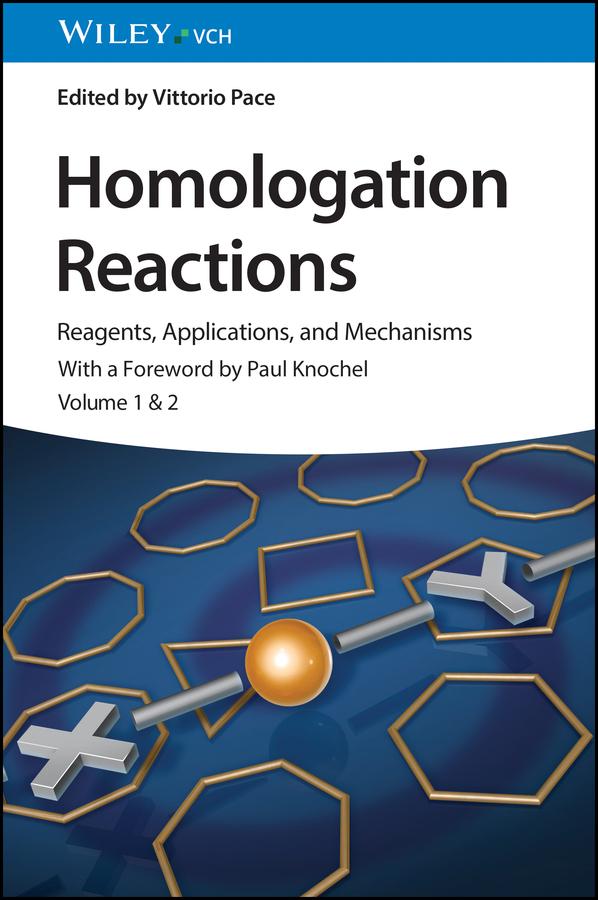
Provides a unique summary of homologation strategies in organic synthesis
Homologation Reactions presents different concepts underpinning the use of homologating reagents as well as their applications in organic synthesis. It covers in-depth discussions on the rationales governing this kind of transformations with a strong emphasis on mechanistic elements modulating critical aspects (e.g. selectivity) of the processes. In addition, this two-volume work features:
- Metal carbenoids, ylides, and diazo reagents
- Homologating agents working under nucleophilic, electrophilic, and radical regime
- Homologations realized on boron-containing or carbon-centered linchpins
- Use of highly sensitive fluorinated homologating agents
- Progressive homologations and the concept of assembly line synthesis
- Homologation processes followed by rearrangement cascades
- Construction of cyclic motifs and ring-expansion
- Homologation reactions with carbon monoxide and carbon dioxide
- New and/or challenging directions to expect in the future
Written by an international team of leaders in the field, the book is a useful guide for designing effective transformations by using homologation reactions. It is a must-read for every synthetic chemist in academia and industry!
Betal enkelt med kort, Klarna, Apple Pay eller Google Pay. Ikke fornøyd? Du har alltid 14 dagers angrerett. Les mer i våre vilkår. Har du spørsmål, send oss en e-post på hello@memmo.org.
Memmo gjør det enklere å studere – uansett hvor du er i verden. Hos oss samler du pensumbøker og smarte studieverktøy på ett og samme sted: sammendrag, quizer, podkaster og flashcards. Og så Ted, din studiekompis som svarer på alt du lurer på. Over 50 000 studenter studerer allerede her – bygget for at du skal lære raskere og stresse mindre.