
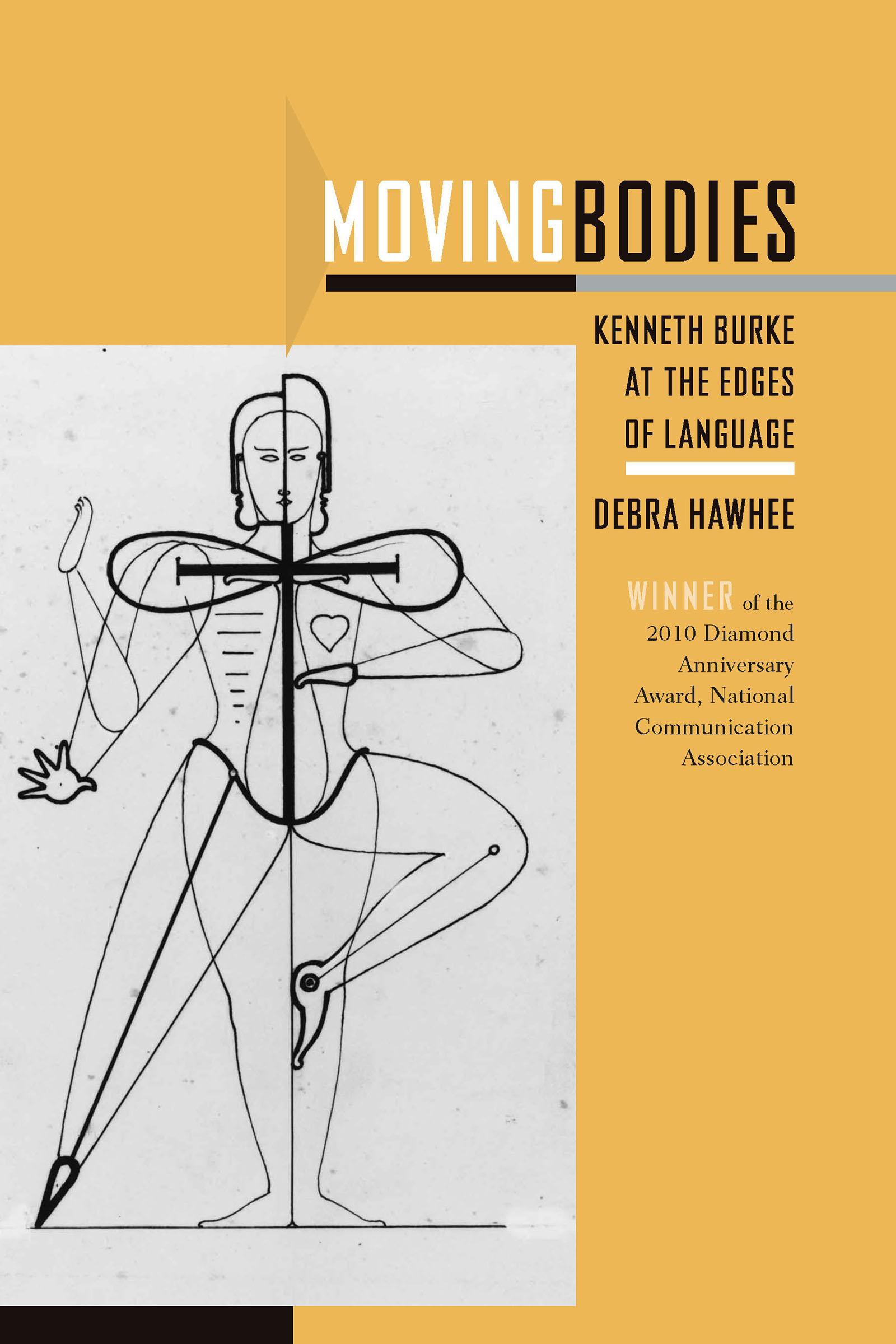
A sophisticated study of how bodies and language move and are moved by each other
Kenneth Burke may be best known for his theories of dramatism and of language as symbolic action, but few know him as one of the twentieth century's foremost theorists of the relationship between language and bodies. In Moving Bodies, Debra Hawhee focuses on Burke's studies from the 1930s, 40s, and 50s while illustrating that his interest in reading the body as a central force of communication began early in his career.
By exploring Burke's extensive writings on the subject alongside revealing considerations of his life and his scholarship, Hawhee maps his recurring invocation of a variety of disciplinary perspectives in order to theorize bodies and communication, working across and even beyond the arts, humanities, and sciences.
Burke's sustained analysis of the body drew on approaches representing a range of specialties and interests, including music, mysticism, endocrinology, evolution, speech-gesture theory, and speech-act theory, as well as his personal experiences with pain and illness. Hawhee shows that Burke's goal was to advance understanding of the body's relationship to identity, to the creation of meaning, and to the circulation of language. Her study brings to the fore one of Burke's most important and understudied contributions to language theory, and she establishes Burke as a pioneer in a field where investigations into affect, movement, and sense perception broaden understanding of physical ways of knowing.
Betal enkelt med kort, Klarna, Apple Pay eller Google Pay. Ikke fornøyd? Du har alltid 14 dagers angrerett. Les mer i våre vilkår. Har du spørsmål, send oss en e-post på hello@memmo.org.
Memmo gjør det enklere å studere – uansett hvor du er i verden. Hos oss samler du pensumbøker og smarte studieverktøy på ett og samme sted: sammendrag, quizer, podkaster og flashcards. Og så Ted, din studiekompis som svarer på alt du lurer på. Over 50 000 studenter studerer allerede her – bygget for at du skal lære raskere og stresse mindre.