
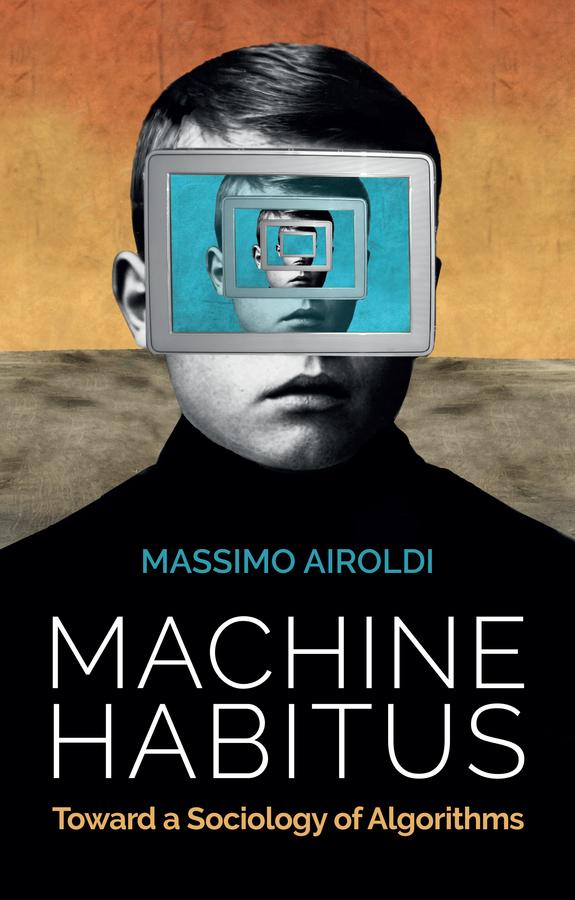
We commonly think of society as made of and by humans, but with the proliferation of machine learning and AI technologies, this is clearly no longer the case. Billions of automated systems tacitly contribute to the social construction of reality by drawing algorithmic distinctions between the visible and the invisible, the relevant and the irrelevant, the likely and the unlikely – on and beyond platforms.
Drawing on the work of Pierre Bourdieu, this book develops an original sociology of algorithms as social agents, actively participating in social life. Through a wide range of examples, Massimo Airoldi shows how society shapes algorithmic code, and how this culture in the code guides the practical behaviour of the code in the culture, shaping society in turn. The ‘machine habitus’ is the generative mechanism at work throughout myriads of feedback loops linking humans with artificial social agents, in the context of digital infrastructures and pre-digital social structures.
Machine Habitus will be of great interest to students and scholars in sociology, media and cultural studies, science and technology studies and information technology, and to anyone interested in the growing role of algorithms and AI in our social and cultural life.
Betal enkelt med kort, Klarna, Apple Pay eller Google Pay. Ikke fornøyd? Du har alltid 14 dagers angrerett. Les mer i våre vilkår. Har du spørsmål, send oss en e-post på hello@memmo.org.
Memmo gjør det enklere å studere – uansett hvor du er i verden. Hos oss samler du pensumbøker og smarte studieverktøy på ett og samme sted: sammendrag, quizer, podkaster og flashcards. Og så Ted, din studiekompis som svarer på alt du lurer på. Over 50 000 studenter studerer allerede her – bygget for at du skal lære raskere og stresse mindre.