
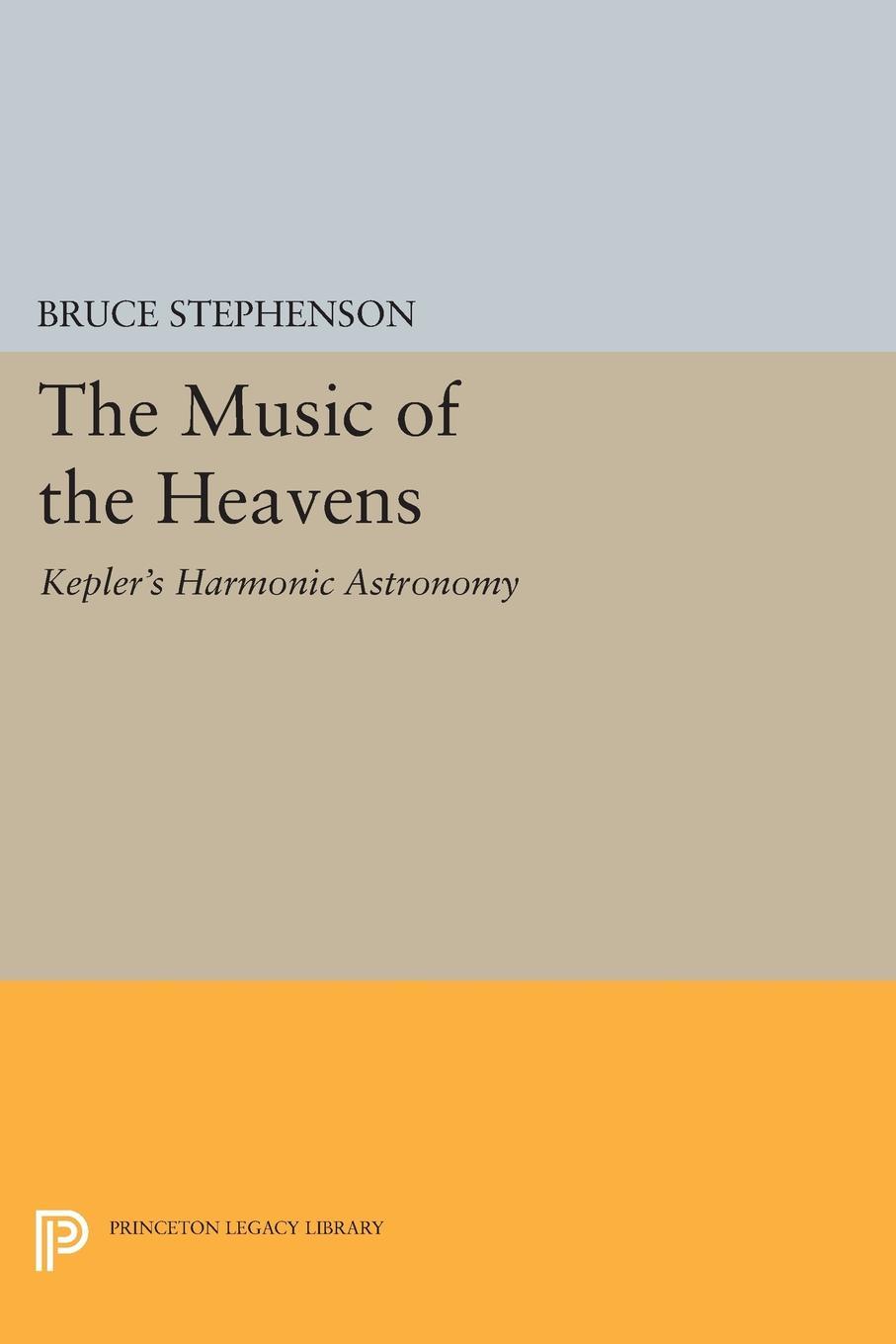
Valued today for its development of the third law of planetary motion, Harmonice mundi (1619) was intended by Kepler to expand on ancient efforts to discern a Creator's plan for the planetary system--an arrangement thought to be based on harmonic relationships. Challenging critics who characterize Kepler's theories of harmonic astronomy as "mystical," Bruce Stephenson offers the first thorough technical analysis of the music the astronomer thought the heavens made, and the logic that led him to find musical patterns in his data. In so doing, Stephenson illuminates crucial aspects of Kepler's intellectual development, particularly his ways of classifying and drawing inferences.
Beginning with a survey of similar theories associating music with the cyclic motions of planets, from Plato to Boethius, the author highlights Ptolemy's Harmonics, a source of inspiration for Kepler's later work. Turning to Kepler himself, Stephenson gives an account of his polyhedral theory, which explains the number and sizes of the planetary orbits in terms of the five regular poly-hedral. He then examines in detail an early theory that relates the planets' vel-ocities to a musical chord, and analyzes Kepler's unpublished commentary on Ptolemy's Harmonics. Devoting most of his attention to Book Five of Harmonice mundi, in which Kepler elaborated on the musical structure of the planetary system, Stephenson lays important groundwork for any further evaluation of Kepler's scientific thought.
Originally published in 1994.
The Princeton Legacy Library uses the latest print-on-demand technology to again make available previously out-of-print books from the distinguished backlist of Princeton University Press. These editions preserve the original texts of these important books while presenting them in durable paperback and hardcover editions. The goal of the Princeton Legacy Library is to vastly increase access to the rich scholarly heritage found in the thousands of books published by Princeton University Press since its founding in 1905.
Betal enkelt med kort, Klarna, Apple Pay eller Google Pay. Ikke fornøyd? Du har alltid 14 dagers angrerett. Les mer i våre vilkår. Har du spørsmål, send oss en e-post på hello@memmo.org.
Memmo gjør det enklere å studere – uansett hvor du er i verden. Hos oss samler du pensumbøker og smarte studieverktøy på ett og samme sted: sammendrag, quizer, podkaster og flashcards. Og så Ted, din studiekompis som svarer på alt du lurer på. Over 50 000 studenter studerer allerede her – bygget for at du skal lære raskere og stresse mindre.