
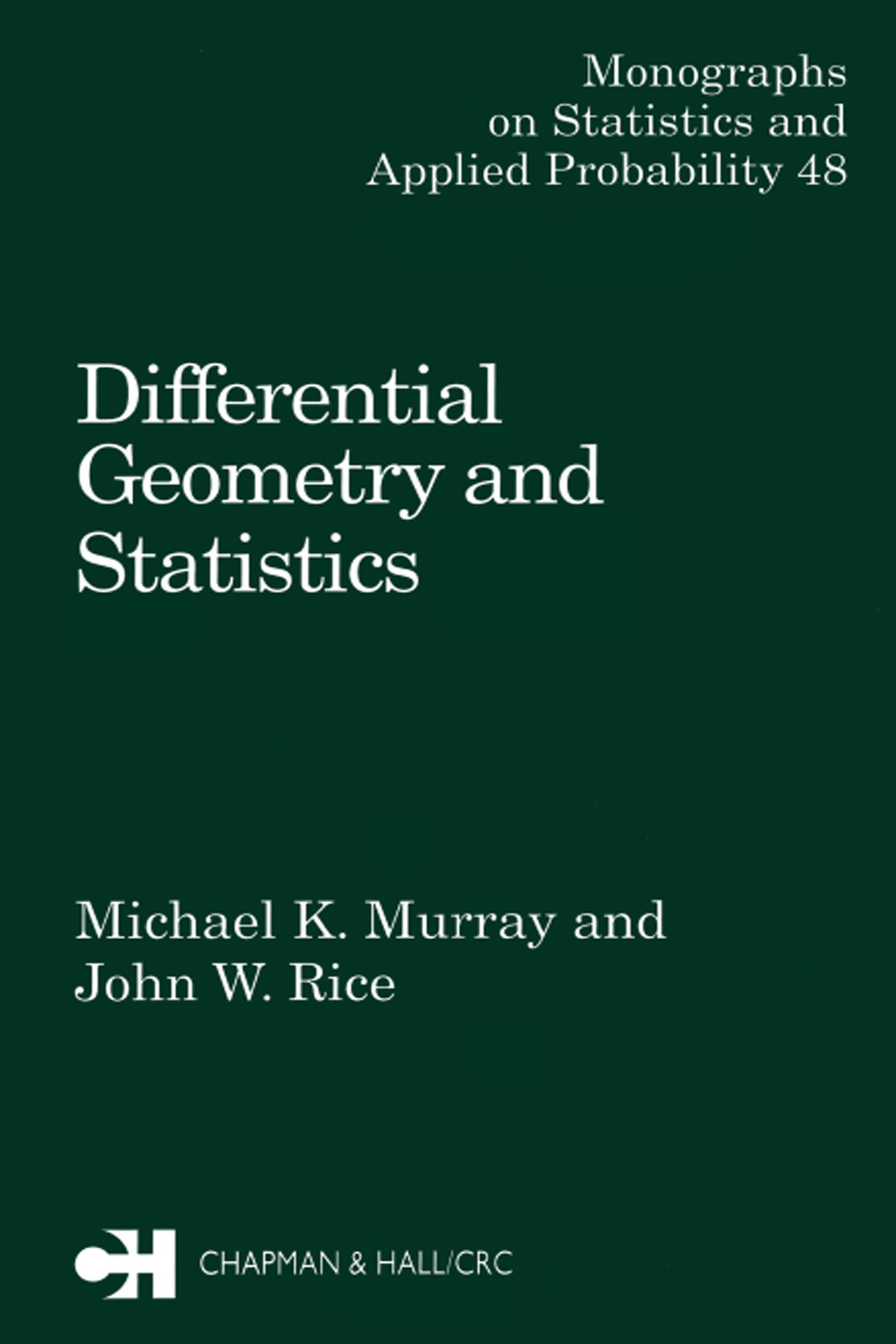
Several years ago our statistical friends and relations introduced us to the work of Amari and Barndorff-Nielsen on applications of differential geometry to statistics. This book has arisen because we believe that there is a deep relationship between statistics and differential geometry and moreoever that this relationship uses parts of differential geometry, particularly its 'higher-order' aspects not readily accessible to a statistical audience from the existing literature. It is, in part, a long reply to the frequent requests we have had for references on differential geometry! While we have not gone beyond the path-breaking work of Amari and Barndorff- Nielsen in the realm of applications, our book gives some new explanations of their ideas from a first principles point of view as far as geometry is concerned. In particular it seeks to explain why geometry should enter into parametric statistics, and how the theory of asymptotic expansions involves a form of higher-order differential geometry. The first chapter of the book explores exponential families as flat geometries. Indeed the whole notion of using log-likelihoods amounts to exploiting a particular form of flat space known as an affine geometry, in which straight lines and planes make sense, but lengths and angles are absent. We use these geometric ideas to introduce the notion of the second fundamental form of a family whose vanishing characterises precisely the exponential families.
Betal enkelt med kort, Klarna, Apple Pay eller Google Pay. Ikke fornøyd? Du har alltid 14 dagers angrerett. Les mer i våre vilkår. Har du spørsmål, send oss en e-post på hello@memmo.org.
Memmo gjør det enklere å studere – uansett hvor du er i verden. Hos oss samler du pensumbøker og smarte studieverktøy på ett og samme sted: sammendrag, quizer, podkaster og flashcards. Og så Ted, din studiekompis som svarer på alt du lurer på. Over 50 000 studenter studerer allerede her – bygget for at du skal lære raskere og stresse mindre.
Du vil kanskje også like
Kjøp boken0