
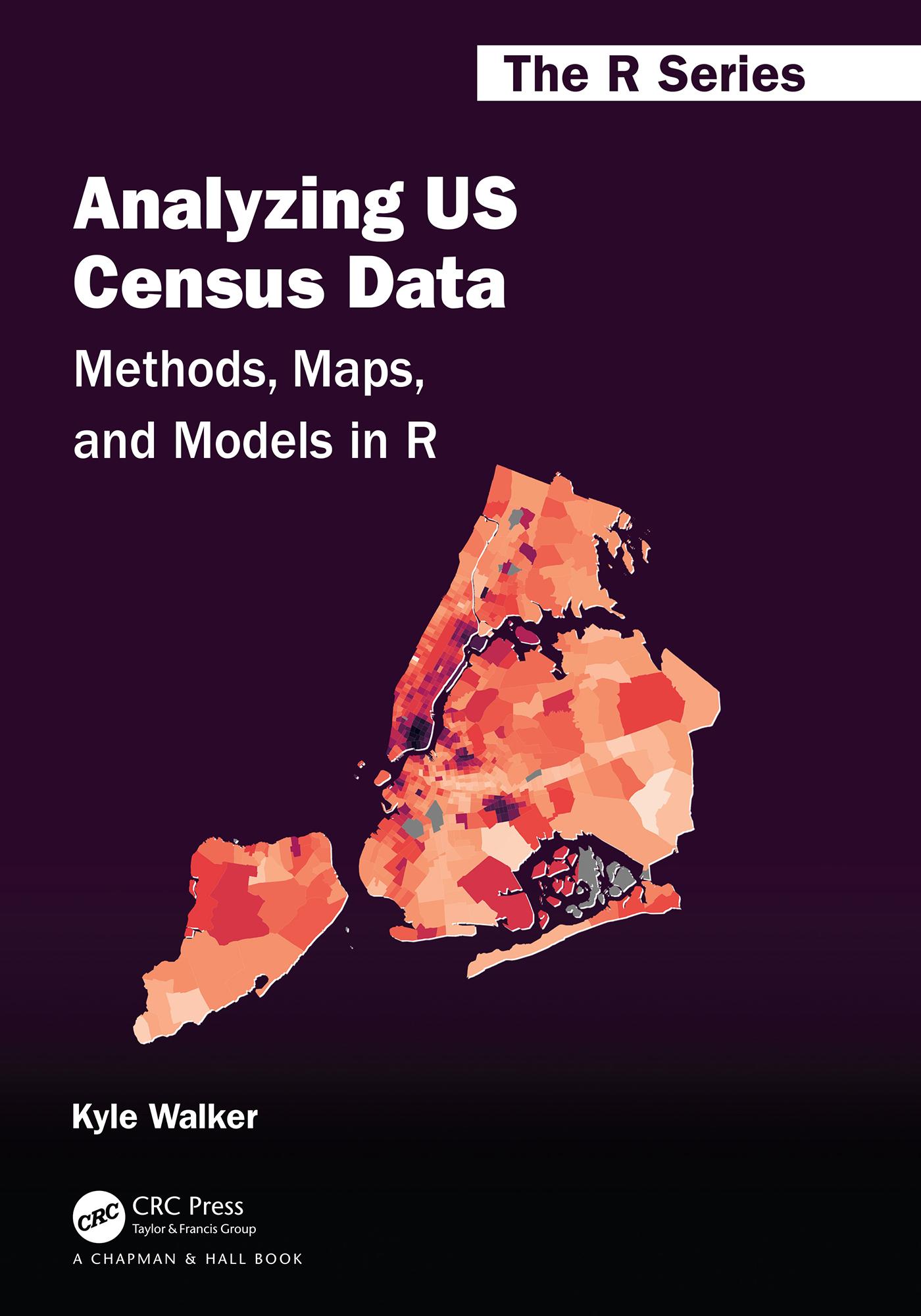
Census data is widely used by practitioners to understand demographic change, allocate resources, address inequalities, and make sound business decisions. Until recently, projects using US Census data have required proficiency with multiple web interfaces and software platforms to prepare, map, and present data products. This book introduces readers to tools in the R programming language for accessing and analyzing Census data and shows how to carry out demographic analyses in a single computing environment.
Chapters in this book cover the following key topics:
• Rapidly acquiring data from the decennial US Census and American Community Survey using R, then analyzing these datasets using tidyverse tools;
• Visualizing US Census data with a wide range of methods including charts in ggplot2 as well as both static and interactive maps;
• Using R as a geographic information system (GIS) to manage, analyze, and model spatial demographic data from the US Census;
• Working with and modeling individual-level microdata from the American Community Survey’s PUMS datasets;
• Applying these tools and workflows to the analysis of historical Census data, other US government datasets, and international Census data from countries like Canada, Brazil, Kenya, and Mexico.
Betal enkelt med kort, Klarna, Apple Pay eller Google Pay. Ikke fornøyd? Du har alltid 14 dagers angrerett. Les mer i våre vilkår. Har du spørsmål, send oss en e-post på hello@memmo.org.
Memmo gjør det enklere å studere – uansett hvor du er i verden. Hos oss samler du pensumbøker og smarte studieverktøy på ett og samme sted: sammendrag, quizer, podkaster og flashcards. Og så Ted, din studiekompis som svarer på alt du lurer på. Over 50 000 studenter studerer allerede her – bygget for at du skal lære raskere og stresse mindre.