
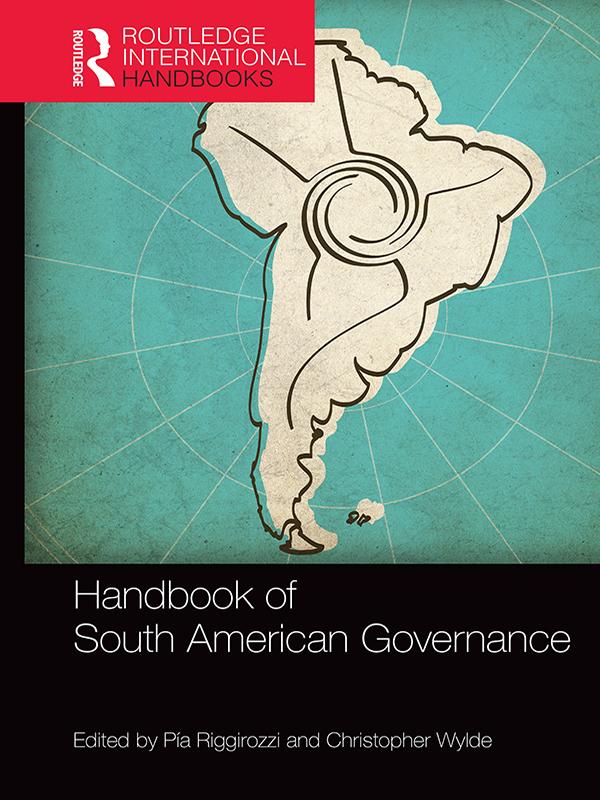
Governance in South America is signified by strategies pursued by state and non-state actors directed to enhancing (some aspect of) their capabilities and powers of agency. It is about the spaces and the practices available, demanded or created to ‘make politics happen’. This framework lends explanatory power to understand how governance has been defined and practiced in South America.
Pía Riggirozzi and Christopher Wylde bring together leading experts to explore what demands and dilemmas have shaped understanding and practice of governance in South America in and across the region. The Handbook suggests that governance dilemmas of inequitable and unfulfilled political economic governance in South America have been constant historical features, yet addressed and negotiated in different ways. Building from an introduction to key issues defining governance in South America, this Handbook proceeds to examine institutions, actors and practices in governance focusing on three core processes: evolution of socio-economic and political justice claims as central to the demands of governance; governance frameworks foregrounding particular issues and often privileging particular forms of political practice; and iterative and cumulative processes leading to new demands of governance addressing recognition and identity politics.
This Handbook will be a key reference for those concerned with the study of South America, South American political economy, regional governance, and the politics of development.
Betal enkelt med kort, Klarna, Apple Pay eller Google Pay. Ikke fornøyd? Du har alltid 14 dagers angrerett. Les mer i våre vilkår. Har du spørsmål, send oss en e-post på hello@memmo.org.
Memmo gjør det enklere å studere – uansett hvor du er i verden. Hos oss samler du pensumbøker og smarte studieverktøy på ett og samme sted: sammendrag, quizer, podkaster og flashcards. Og så Ted, din studiekompis som svarer på alt du lurer på. Over 50 000 studenter studerer allerede her – bygget for at du skal lære raskere og stresse mindre.