
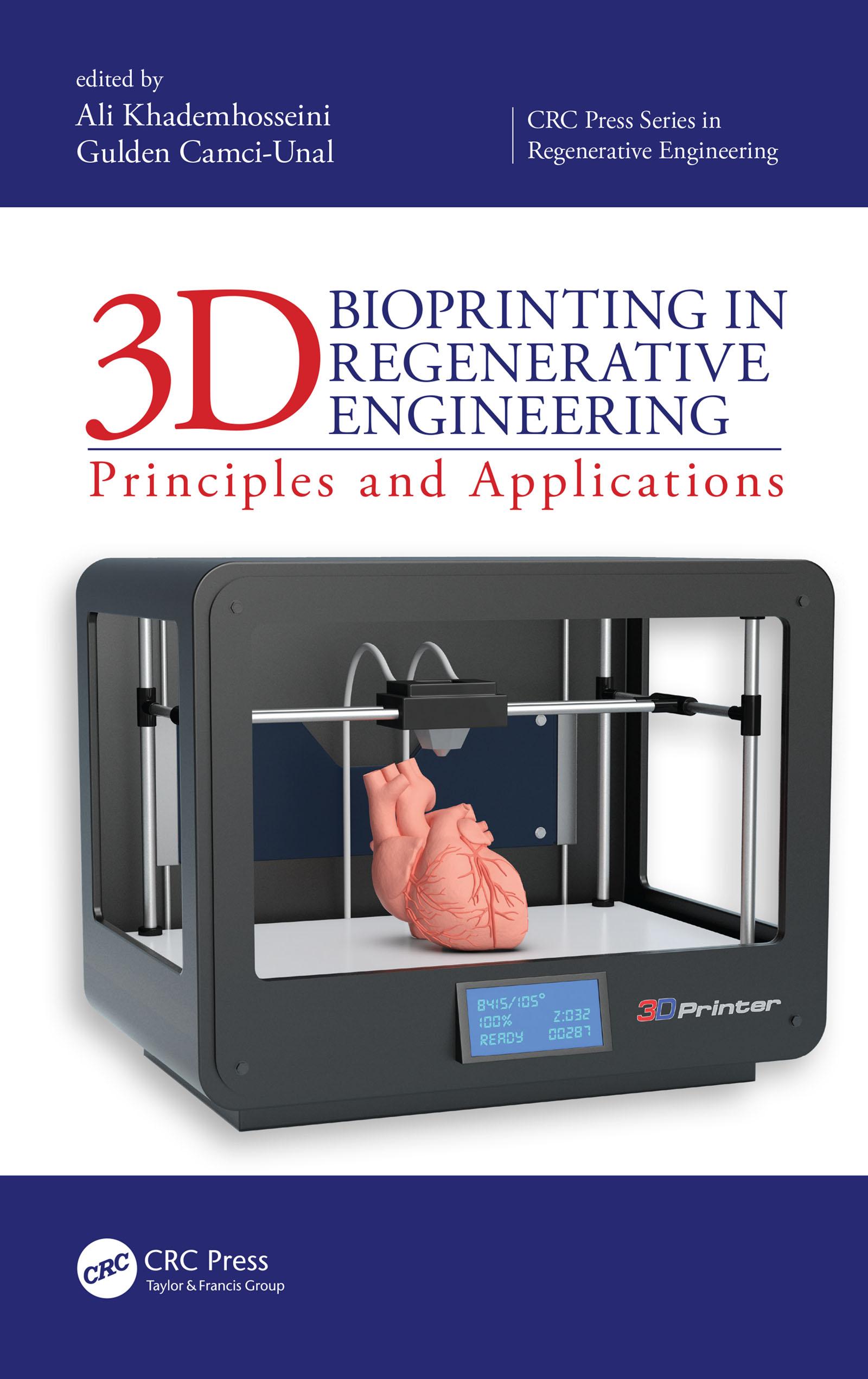
Regenerative engineering is the convergence of developmental biology, stem cell science and engineering, materials science, and clinical translation to provide tissue patches or constructs for diseased or damaged organs. Various methods have been introduced to create tissue constructs with clinically relevant dimensions. Among such methods, 3D bioprinting provides the versatility, speed and control over location and dimensions of the deposited structures.
Three-dimensional bioprinting has leveraged the momentum in printing and tissue engineering technologies and has emerged as a versatile method of fabricating tissue blocks and patches. The flexibility of the system lies in the fact that numerous biomaterials encapsulated with living cells can be printed. This book contains an extensive collection of papers by world-renowned experts in 3D bioprinting. In addition to providing entry-level knowledge about bioprinting, the authors delve into the latest advances in this technology. Furthermore, details are included about the different technologies used in bioprinting. In addition to the equipment for bioprinting, the book also describes the different biomaterials and cells used in these approaches. This text:
- Presents the principles and applications of bioprinting
- Discusses bioinks for 3D printing
- Explores applications of extrusion bioprinting, including past, present, and future challenges
- Includes discussion on 4D Bioprinting in terms of mechanisms and applications
Betal enkelt med kort, Klarna, Apple Pay eller Google Pay. Ikke fornøyd? Du har alltid 14 dagers angrerett. Les mer i våre vilkår. Har du spørsmål, send oss en e-post på hello@memmo.org.
Memmo gjør det enklere å studere – uansett hvor du er i verden. Hos oss samler du pensumbøker og smarte studieverktøy på ett og samme sted: sammendrag, quizer, podkaster og flashcards. Og så Ted, din studiekompis som svarer på alt du lurer på. Over 50 000 studenter studerer allerede her – bygget for at du skal lære raskere og stresse mindre.