
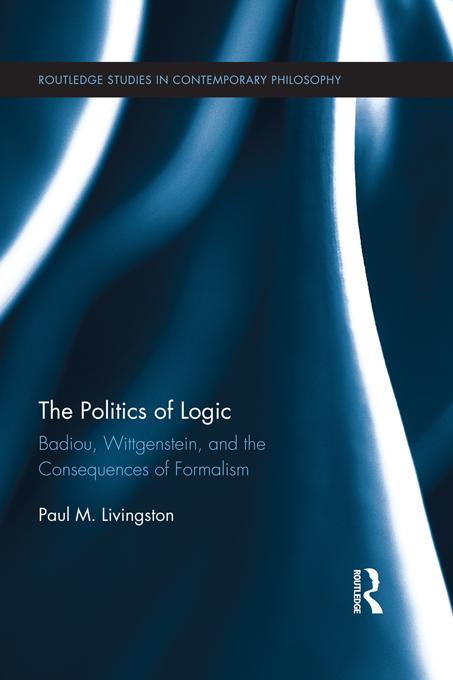
In this book, Livingston develops the political implications of formal results obtained over the course of the twentieth century in set theory, metalogic, and computational theory. He argues that the results achieved by thinkers such as Cantor, Russell, Godel, Turing, and Cohen, even when they suggest inherent paradoxes and limitations to the structuring capacities of language or symbolic thought, have far-reaching implications for understanding the nature of political communities and their development and transformation. Alain Badiou's analysis of logical-mathematical structures forms the backbone of his comprehensive and provocative theory of ontology, politics, and the possibilities of radical change. Through interpretive readings of Badiou's work as well as the texts of Giorgio Agamben, Jacques Lacan, Jacques Derrida, Gilles Deleuze, and Ludwig Wittgenstein, Livingston develops a formally based taxonomy of critical positions on the nature and structure of political communities. These readings, along with readings of Parmenides and Plato, show how the formal results can transfigure two interrelated and ancient problems of the One and the Many: the problem of the relationship of a Form or Idea to the many of its participants, and the problem of the relationship of a social whole to its many constituents.
Betal enkelt med kort, Klarna, Apple Pay eller Google Pay. Ikke fornøyd? Du har alltid 14 dagers angrerett. Les mer i våre vilkår. Har du spørsmål, send oss en e-post på hello@memmo.org.
Memmo gjør det enklere å studere – uansett hvor du er i verden. Hos oss samler du pensumbøker og smarte studieverktøy på ett og samme sted: sammendrag, quizer, podkaster og flashcards. Og så Ted, din studiekompis som svarer på alt du lurer på. Over 50 000 studenter studerer allerede her – bygget for at du skal lære raskere og stresse mindre.
Du vil kanskje også like
Kjøp boken0