
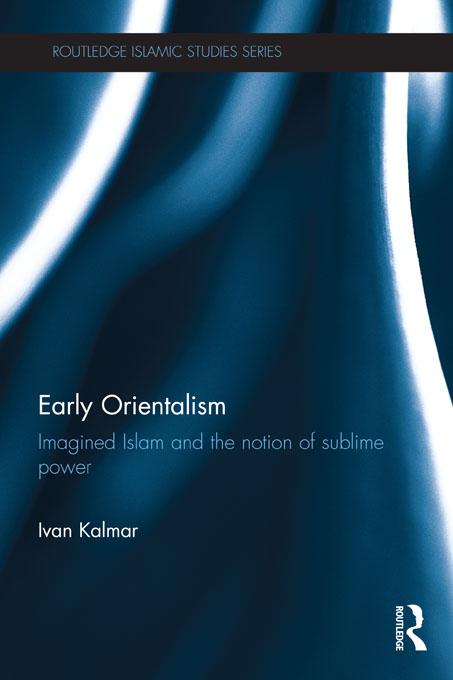
The history of western notions about Islam is of obvious scholarly as well as popular interest today. This book investigates Christian images of the Muslim Middle East, focusing on the period from the Renaissance to the Enlightenment, when the nature of divine as well as human power was under particularly intense debate in the West.
Ivan Kalmar explores how the controversial notion of submission to ultimate authority has in the western world been discussed with reference to Islam’s alleged recommendation to obey, unquestioningly, a merciless Allah in heaven and a despotic government on earth. He discusses how Abrahamic faiths – Christianity and Judaism as much as Islam – demand devotion to a sublime power, with the faith that this power loves and cares for us, a concept that brings with it the fear that, on the contrary, this power only toys with us for its own enjoyment. For such a power, Kalmar borrows Slavoj Zizek’s term "obscene father". He discusses how this describes exactly the western image of the Oriental despot - Allah in heaven, and the various sultans, emirs and ayatollahs on earth – and how these despotic personalities of imagined Muslim society function as a projection, from the West on to the Muslim Orient, of an existential anxiety about sublime power.
Making accessible academic debates on the history of Christian perceptions of Islam and on Islam and the West, this book is an important addition to the existing literature in the areas of Islamic studies, religious history and philosophy.
Betal enkelt med kort, Klarna, Apple Pay eller Google Pay. Ikke fornøyd? Du har alltid 14 dagers angrerett. Les mer i våre vilkår. Har du spørsmål, send oss en e-post på hello@memmo.org.
Memmo gjør det enklere å studere – uansett hvor du er i verden. Hos oss samler du pensumbøker og smarte studieverktøy på ett og samme sted: sammendrag, quizer, podkaster og flashcards. Og så Ted, din studiekompis som svarer på alt du lurer på. Over 50 000 studenter studerer allerede her – bygget for at du skal lære raskere og stresse mindre.