
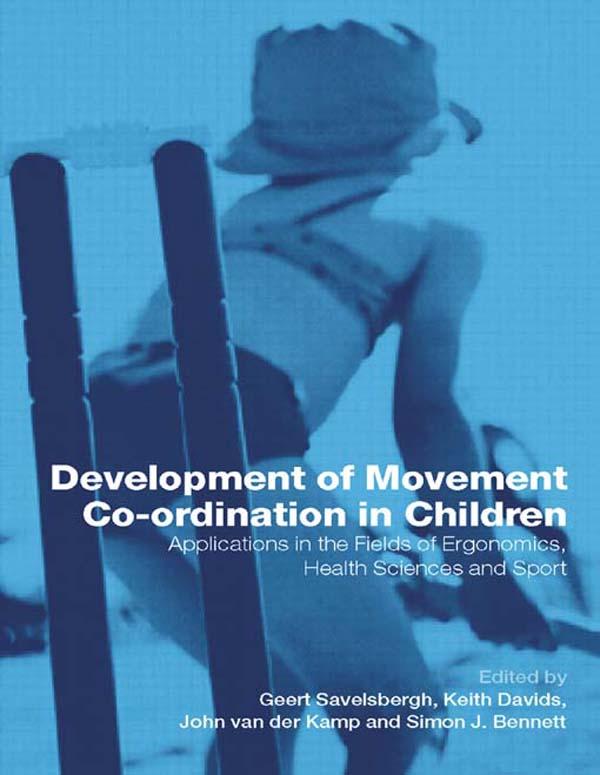
Co-ordination of movement plays a key role in human development and is an important area in sport and health sciences. This book looks in detail at how children develop basic skills, such as walking and reaching for objects, and more complex skills such as throwing and catching a ball accurately or riding a bicycle.
Development of Movement Co-ordination in Children is informed by five major theoretical perspectives and are explained in an introductory chapter:
* neural maturation
* information processing
* direct perception
* dynamic systems
* constraint theory.
The international contributions are brought together under the headings of ergonomics, health sciences and sport. Focusing on practical applications, individual chapters cover many different aspects of movement behaviour and development, ranging from children's over-estimation of their physical abilities and the links to injury proneness, to the co-ordination of kicking techniques. Both normal and abnormal development is considered.
This text will be of considerable interest to students, teachers and professionals in the fields of sport science, kinesiology, physical education, ergonomics and developmental psychology.
Betal enkelt med kort, Klarna, Apple Pay eller Google Pay. Ikke fornøyd? Du har alltid 14 dagers angrerett. Les mer i våre vilkår. Har du spørsmål, send oss en e-post på hello@memmo.org.
Memmo gjør det enklere å studere – uansett hvor du er i verden. Hos oss samler du pensumbøker og smarte studieverktøy på ett og samme sted: sammendrag, quizer, podkaster og flashcards. Og så Ted, din studiekompis som svarer på alt du lurer på. Over 50 000 studenter studerer allerede her – bygget for at du skal lære raskere og stresse mindre.