
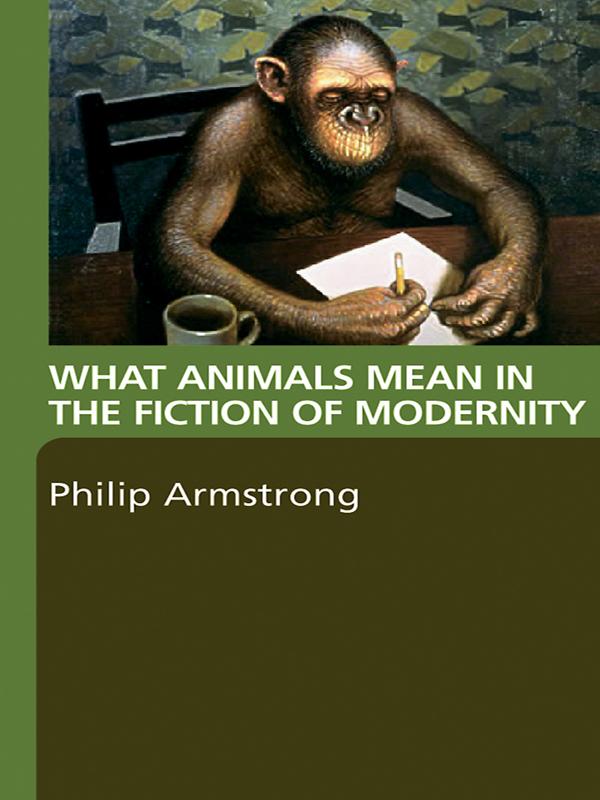
What Animals Mean in the Fiction of Modernity argues that nonhuman animals, and stories about them, have always been closely bound up with the conceptual and material work of modernity.
In the first half of the book, Philip Armstrong examines the function of animals and animal representations in four classic narratives: Robinson Crusoe, Gulliver’s Travels, Frankenstein and Moby-Dick. He then goes on to explore how these stories have been re-worked, in ways that reflect shifting social and environmental forces, by later novelists, including H.G. Wells, Upton Sinclair, D.H. Lawrence, Ernest Hemingway, Franz Kafka, Brigid Brophy, Bernard Malamud, Timothy Findley, Will Self, Margaret Atwood, Yann Martel and J.M. Coetzee.
What Animals Mean in the Fiction of Modernity also introduces readers to new developments in the study of human-animal relations. It does so by attending both to the significance of animals to humans, and to animals’ own purposes or designs; to what animals mean to us, and to what they mean to do, and how they mean to live.
Betal enkelt med kort, Klarna, Apple Pay eller Google Pay. Ikke fornøyd? Du har alltid 14 dagers angrerett. Les mer i våre vilkår. Har du spørsmål, send oss en e-post på hello@memmo.org.
Memmo gjør det enklere å studere – uansett hvor du er i verden. Hos oss samler du pensumbøker og smarte studieverktøy på ett og samme sted: sammendrag, quizer, podkaster og flashcards. Og så Ted, din studiekompis som svarer på alt du lurer på. Over 50 000 studenter studerer allerede her – bygget for at du skal lære raskere og stresse mindre.