
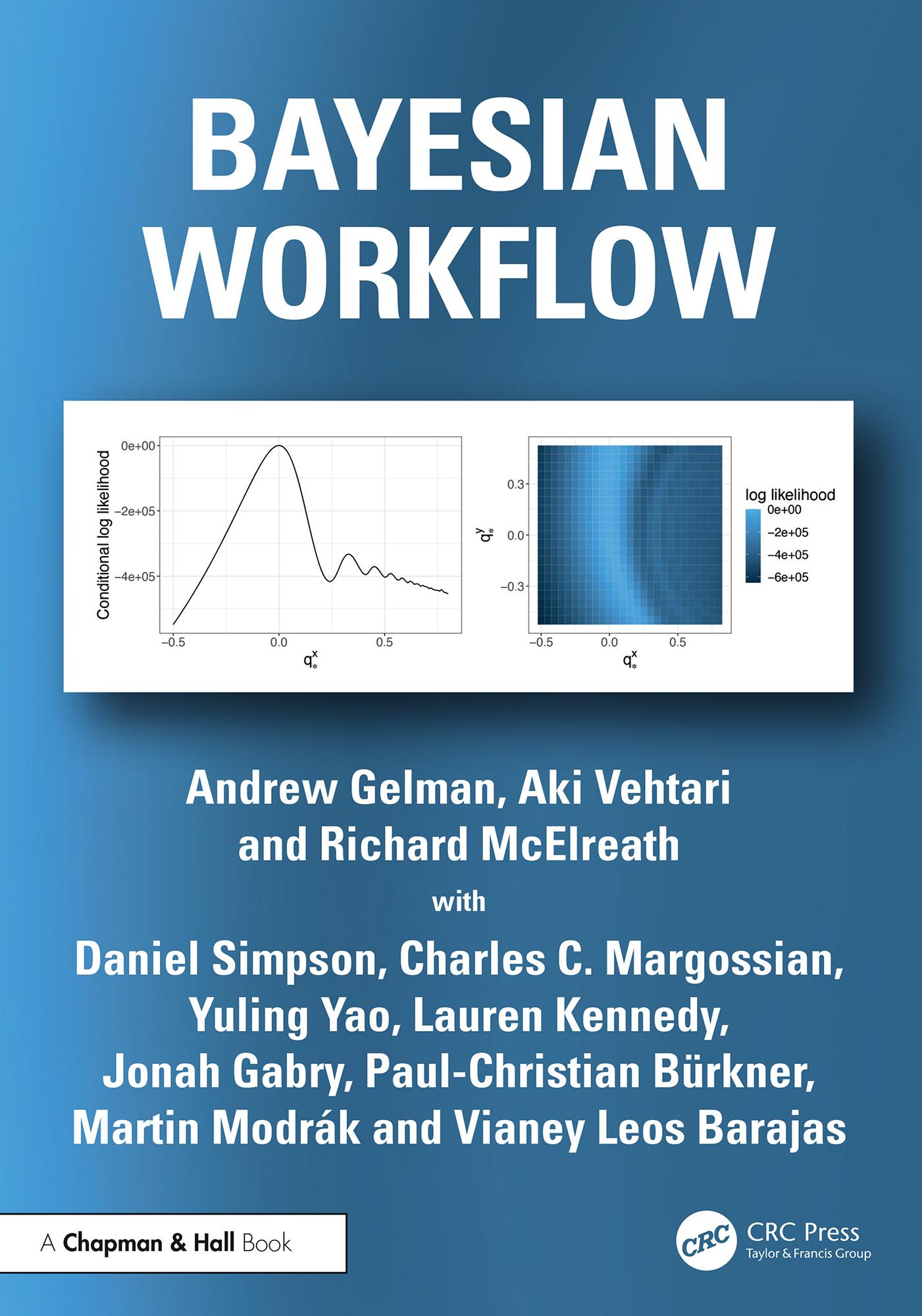
Bayesian statistics and statistical practice have evolved over the years, driven by advancements in theory, methods, and computational tools. Bayesian Workflow explores the intricate workflows of applied Bayesian statistics, aiming to uncover the tacit knowledge often overlooked in published papers and textbooks. By systematizing the process of Bayesian model development, the book seeks to improve applied analyses and inspire future innovations in theory, methods, and software. It emphasizes the importance of iterative model building, model checking, computational troubleshooting, and simulated-data experimentation, offering a comprehensive perspective on statistical analysis.
Through detailed examples and practical guidance, the book bridges the gap between theory and application, empowering practitioners and researchers to navigate the complexities of Bayesian inference. It is not a checklist or cookbook but a flexible framework for understanding and resolving challenges in statistical modeling and decision-making under uncertainty.
Features
- Covers all aspects of Bayesian statistical workflow, including model building, inference, validation, troubleshooting, and understanding
- Demonstrates iterative model development and computational problem-solving through real-world case studies
- Explores computational challenges, calibration checking, and connections between modeling and computation
- Highlights the importance of checking models under diverse conditions to understand their limitations and improve their robustness
- Discusses how Bayesian principles apply to non-Bayesian methods in statistics and machine learning
- Includes code snippets, exercises, and links to full datasets and code in R and Stan, with applicability to other programming environments like Python and Julia
This book is designed for practitioners of applied Bayesian statistics, particularly users of probabilistic programming languages such as Stan, as well as developers of methods and software tailored to these users. It also targets researchers in Bayesian theory and methods, offering insights into understudied aspects of statistical workflows. Instructors and students will find adaptable exercises and case studies to enhance their learning experience. Beyond Bayesian inference, the book’s principles are relevant to users of non-Bayesian methods, making it a valuable resource for statisticians, data scientists, and machine learning professionals seeking to improve their modeling and decision-making processes.
Betal enkelt med kort, Klarna, Apple Pay eller Google Pay. Ikke fornøyd? Du har alltid 14 dagers angrerett. Les mer i våre vilkår. Har du spørsmål, send oss en e-post på hello@memmo.org.
Memmo gjør det enklere å studere – uansett hvor du er i verden. Hos oss samler du pensumbøker og smarte studieverktøy på ett og samme sted: sammendrag, quizer, podkaster og flashcards. Og så Ted, din studiekompis som svarer på alt du lurer på. Over 50 000 studenter studerer allerede her – bygget for at du skal lære raskere og stresse mindre.