
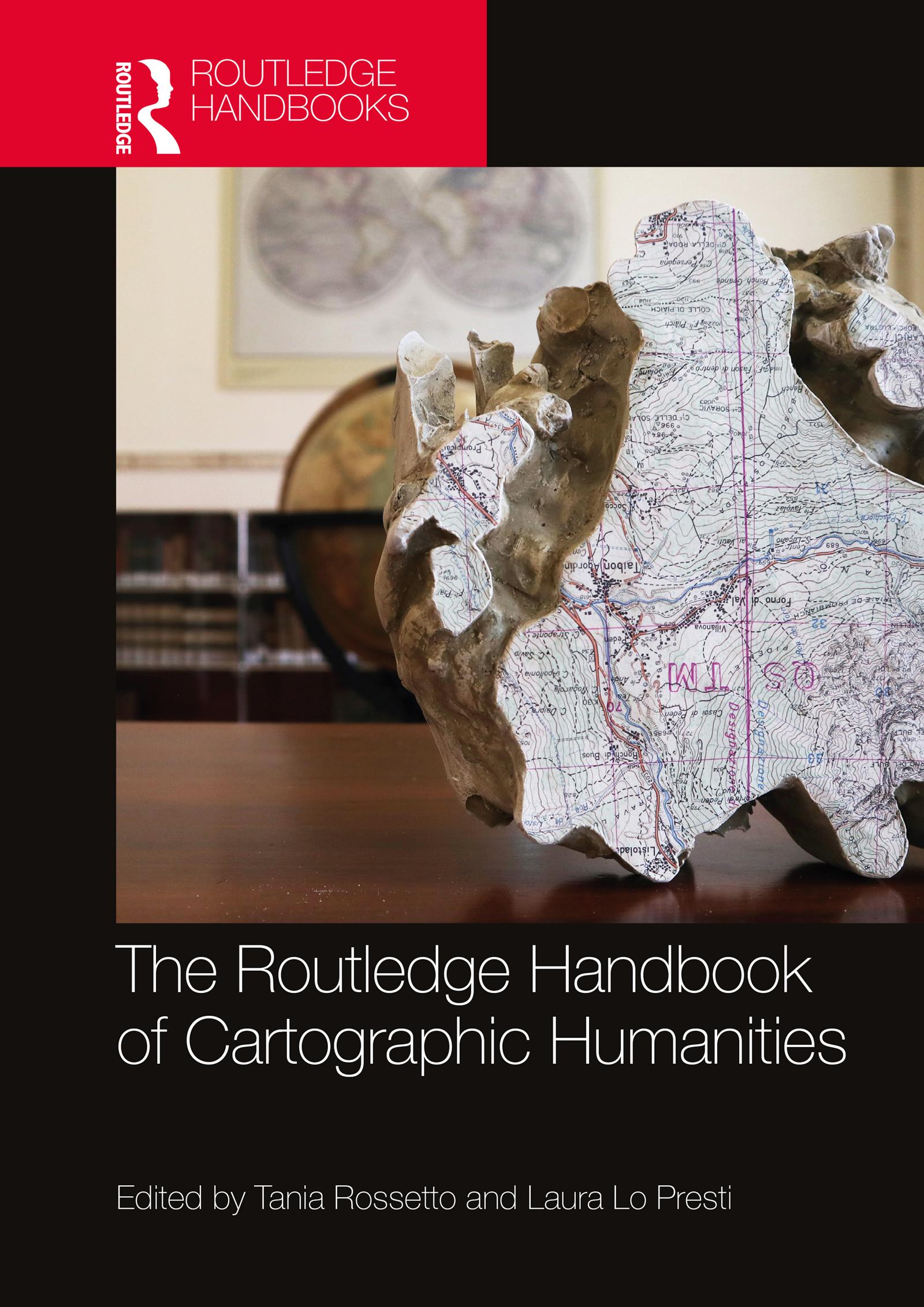
The Routledge Handbook of Cartographic Humanities offers a vibrant exploration of the intersection and convergence between map studies and the humanities through the multifaceted traditions and inclinations from different disciplinary, geographical and cultural contexts.
With 42 chapters from leading scholars, this book provides an intellectual infrastructure to navigate core theories, critical concepts, phenomenologies and ecologies of mapping, while also providing insights into exciting new directions for future scholarship. It is organised into seven parts:
- Part 1 moves from the depths of the humans–maps relation to the posthuman dimension, from antiquity to the future of humanity, presenting a multidisciplinary perspective that bridges chronological distances, introspective instances and social engagements.
- Part 2 draws on ancient, archaeological, historical and literary sources, to consider the materialities and textures embedded in such texts. Fictional and non-fictional cartographies are explored, including layers of time, mobile historical phenomena, unmappable terrain features, and even animal perspectives.
- Part 3 examines maps and mappings from a medial perspective, offering theoretical insight into cartographic mediality as well as studies of its intermedial relations with other media.
- Part 4 explores how a cultural cartographic perspective can be productive in researching the digital as a human experience, considering the development of a cultural attentiveness to a wide range of map-related phenomena that interweave human subjectivities and nonhuman entities in a digital ecology.
- Part 5 addresses a range of issues and urgencies that have been, and still are, at the centre of critical cartographic thinking, from politics, inequalities and discrimination.
- Part 6 considers the growing amount of literature and creative experimentation that involve mapping in practices of eliciting individual life histories, collective identities and self-accounts.
- Part 7 examines the variety of ways in which we can think of maps in the public realm.
This innovative and expansive Handbook will appeal to those in the fields of geography, art, philosophy, media and visual studies, anthropology, history, digital humanities and cultural studies as well as industry professionals.
Betal enkelt med kort, Klarna, Apple Pay eller Google Pay. Ikke fornøyd? Du har alltid 14 dagers angrerett. Les mer i våre vilkår. Har du spørsmål, send oss en e-post på hello@memmo.org.
Memmo gjør det enklere å studere – uansett hvor du er i verden. Hos oss samler du pensumbøker og smarte studieverktøy på ett og samme sted: sammendrag, quizer, podkaster og flashcards. Og så Ted, din studiekompis som svarer på alt du lurer på. Over 50 000 studenter studerer allerede her – bygget for at du skal lære raskere og stresse mindre.