
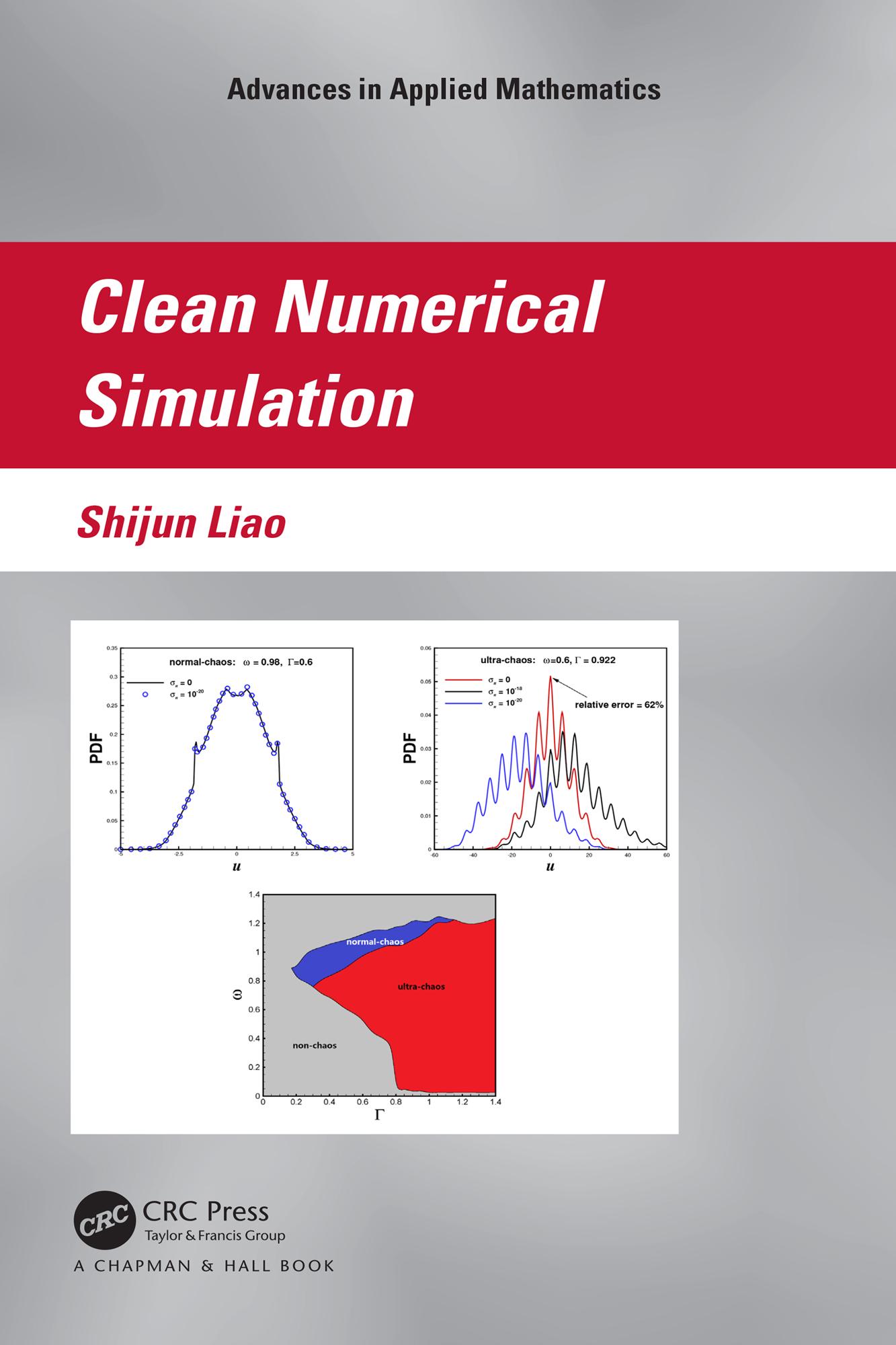
This book describes the basic principles of Clean Numerical Simulation (CNS) proposed by the author in 2009, as well as several of its applications. Unlike conventional algorithms, CNS gives in a sufficiently long interval of time a convergent chaotic trajectory whose numerical noise is much lower than the true physical solution, so that one can gain accurately. Thus, CNS provides for the first time an ability to check statistics stability of chaos, leading to a completely new concept of "ultra-chaos," which has both trajectory instability and statistics instability, and thus is of a higher disorder.
Notably, it is impossible to repeat experimental results of ultra-chaos even in the statistical sense. However, the reproducibility of physical experiments forms a cornerstone for modern science. Thus, ultra-chaos reveals an incompleteness of the modern science paradigm. In addition, it also reveals statistics stability as a precondition for use of conventional algorithms, including direct numerical simulation (DNS). In Clean Numerical Simulation, several conjectures and open problems are proposed, including a modified fourth Clay millennium problem.
Indeed, CNS opens the door for us to enter the "clean" numerical world of chaos and turbulence.
Betal enkelt med kort, Klarna, Apple Pay eller Google Pay. Ikke fornøyd? Du har alltid 14 dagers angrerett. Les mer i våre vilkår. Har du spørsmål, send oss en e-post på hello@memmo.org.
Memmo gjør det enklere å studere – uansett hvor du er i verden. Hos oss samler du pensumbøker og smarte studieverktøy på ett og samme sted: sammendrag, quizer, podkaster og flashcards. Og så Ted, din studiekompis som svarer på alt du lurer på. Over 50 000 studenter studerer allerede her – bygget for at du skal lære raskere og stresse mindre.