
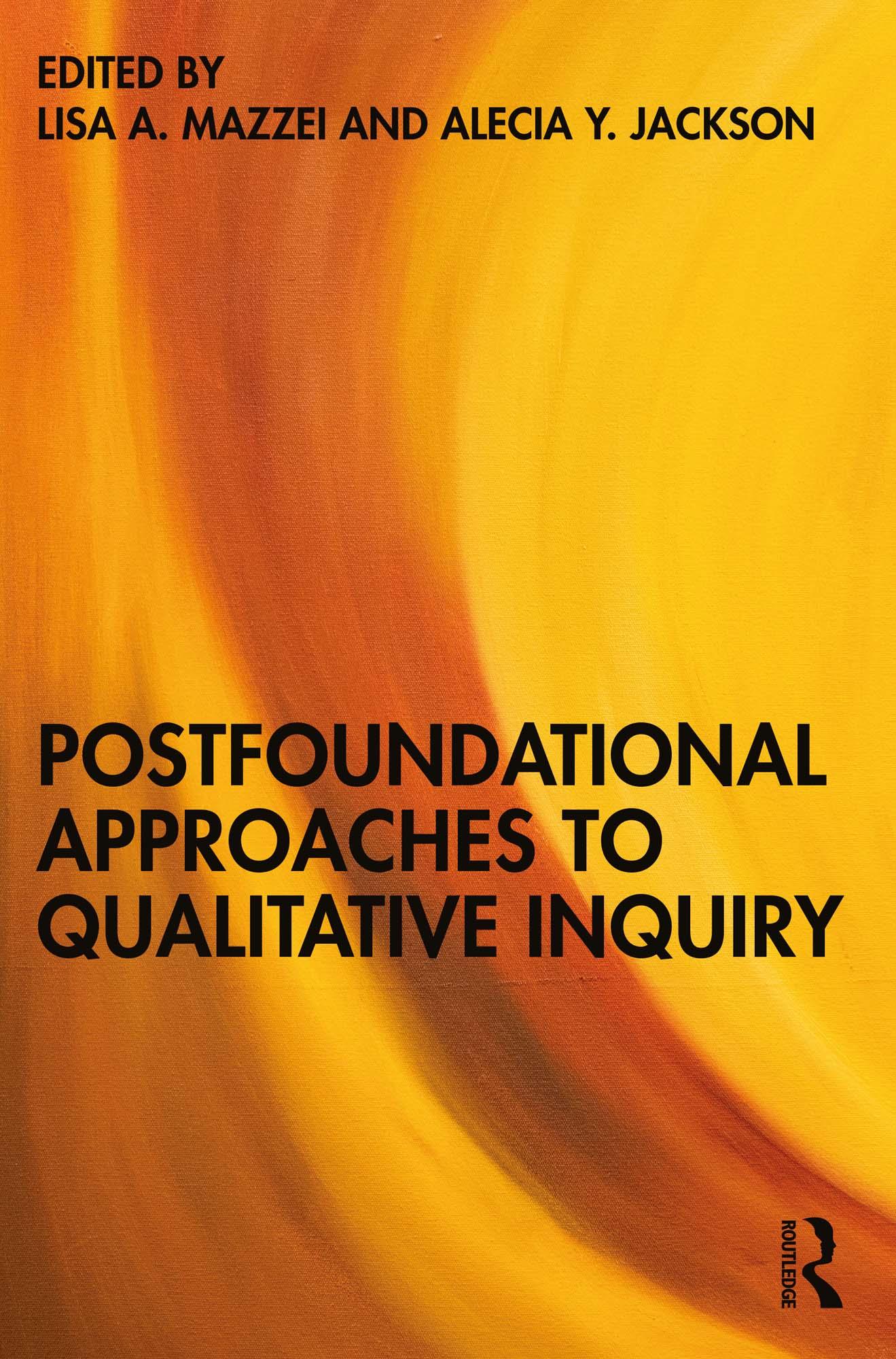
Postfoundational Approaches to Qualitative Inquiry is an edited collection that aims to move beyond a critique and deconstruction of method in order to present an engagement with various postfoundational frameworks and approaches that produce new concepts and enactments. What makes this book innovative is the singular focus on postfoundational paradigms, borrowed from the humanities and sciences, that are enveloped in what is referred to as the ontological turn, the new empiricisms, and the new materialisms.
Postfoundational inquiry is conceived by the editors as emergent, relational, responsive, involuntary, and inventive. While the editors name the facets of these contingent approaches and explain how they work, they do so not in order to fix a new method, but to spur new connectives. In this collection, authors take up a range of postfoundational theories such as poststructuralism, posthumanism, postcolonialism, feminist new materialism, speculative/ new empiricism, agential realism, immanent ontologies, and affect theory. Provoked by a series of reorienting questions, chapters in the book offer enactments as a way of unfurling what is unthought, not yet, and becoming. The chapters are organized according to four Openings: Atmospheres, Affects, and Hauntings; Archives, Worldings, and Sketchings; Escaping Tradition, Beginning Elsewhere, and the Politics of Doing Otherwise; Pre-personal Agencies and Thought Taking Flight.
This book can be used as a standalone text in advanced qualitative inquiry courses, or as a supplementary text in courses that examine the use of theory in research.
Betal enkelt med kort, Klarna, Apple Pay eller Google Pay. Ikke fornøyd? Du har alltid 14 dagers angrerett. Les mer i våre vilkår. Har du spørsmål, send oss en e-post på hello@memmo.org.
Memmo gjør det enklere å studere – uansett hvor du er i verden. Hos oss samler du pensumbøker og smarte studieverktøy på ett og samme sted: sammendrag, quizer, podkaster og flashcards. Og så Ted, din studiekompis som svarer på alt du lurer på. Over 50 000 studenter studerer allerede her – bygget for at du skal lære raskere og stresse mindre.