
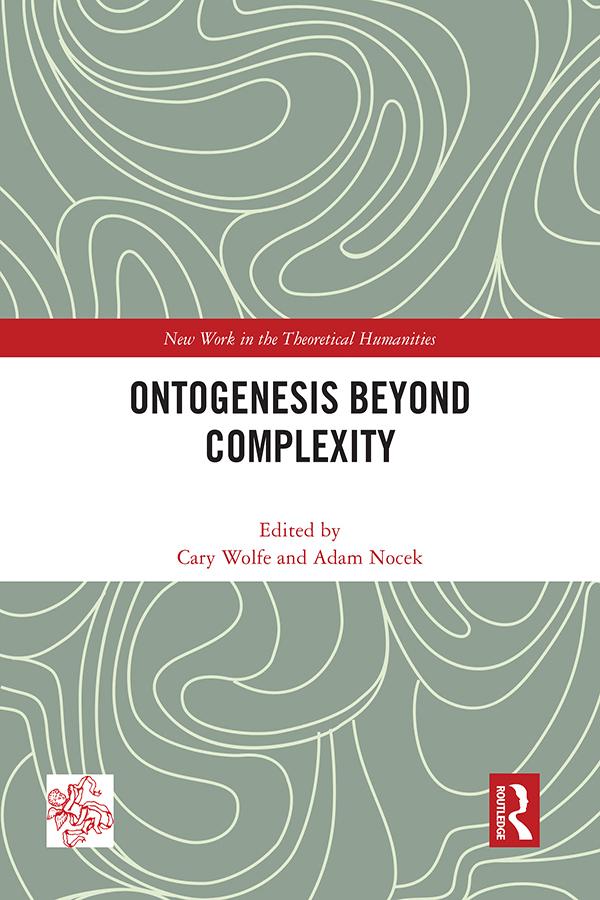
This book is based upon the collaborative efforts of the Ontogenetics Process Group (OPG) – an interdisciplinary, multi-institutional, multi-national research group that began meeting in 2017 to explore new and innovative ways of thinking the problem of complexity in living, physical, and social systems outside the algorithmic models that have dominated paradigms of complexity to date.
For all the descriptive and predictive power that the complexity sciences offer (the ability to compute feedback systems, recursive networks, emergent dynamics, etc.), they also presume that the living world in all of its modalities (biological, semiotic, economic, affective, social) can be reduced to finite schema of description that delimits in advance all possible outcomes. What is proposed in this volume are conceptual architectures for the living that are not only irreducible to physico-mathematical frames of reference, but that are also as vital as the phenomena they wish to express. In short: life is more complex than complexity. What emerges from this engagement is not the ascendance of a new transcendental principle (or, what amounts to the same thing, a foundational bedrock) derived from the physico-mathematical sciences, but just the opposite: a domain in which the ontological and the epistemological domains enter a zone of strange (and unavoidable) entanglement.
The chapters in this book were originally published as a special issue of Angelaki.
Betal enkelt med kort, Klarna, Apple Pay eller Google Pay. Ikke fornøyd? Du har alltid 14 dagers angrerett. Les mer i våre vilkår. Har du spørsmål, send oss en e-post på hello@memmo.org.
Memmo gjør det enklere å studere – uansett hvor du er i verden. Hos oss samler du pensumbøker og smarte studieverktøy på ett og samme sted: sammendrag, quizer, podkaster og flashcards. Og så Ted, din studiekompis som svarer på alt du lurer på. Over 50 000 studenter studerer allerede her – bygget for at du skal lære raskere og stresse mindre.