
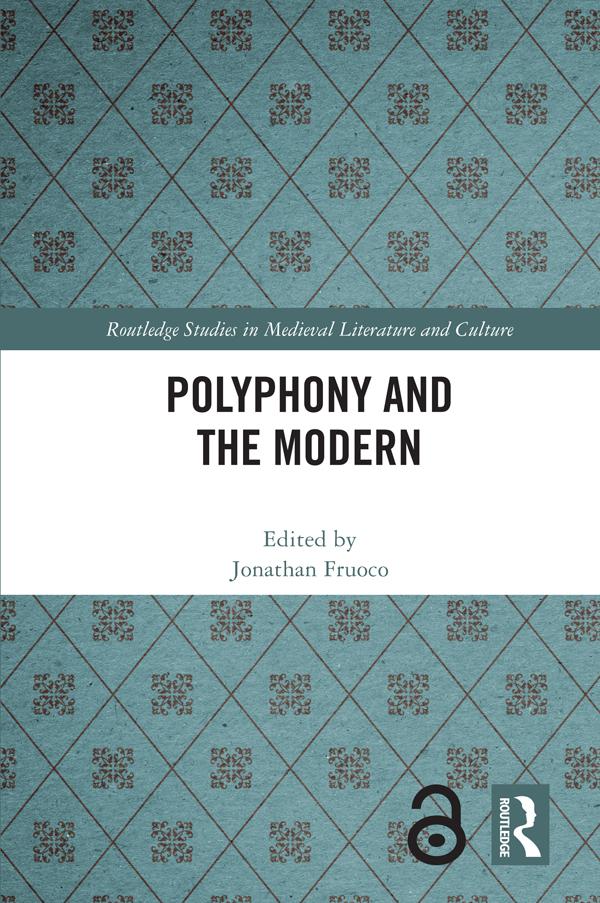
Polyphony and the Modern asks one fundamental question: what does it mean to be modern in one’s own time? To answer that question, this volume focuses on polyphony as an index of modernity.
In The Principle of Hope, Ernst Bloch showed that each moment in time is potentially fractured: people living in the same country can effectively live in different centuries – some making their alliances with the past and others betting on the future – but all of them, at least technically, enclosed in the temporal moment. But can a claim of modernity also mean something more ambitious? Can an artist, by accident or design, escape the limits of his or her own time, and somehow precociously embody the outlook of a subsequent age?
This book sees polyphony as a bridge providing a terminology and a stylistic practice by which the period barrier between Medieval and Early Modern can be breached.
Chapter 1 of this book is freely available as a downloadable Open Access PDF under a Creative Commons Attribution-Non Commercial-No Derivatives 4.0 license available at https://www.taylorfrancis.com/books/edit/10.4324/9781003129837
Betal enkelt med kort, Klarna, Apple Pay eller Google Pay. Ikke fornøyd? Du har alltid 14 dagers angrerett. Les mer i våre vilkår. Har du spørsmål, send oss en e-post på hello@memmo.org.
Memmo gjør det enklere å studere – uansett hvor du er i verden. Hos oss samler du pensumbøker og smarte studieverktøy på ett og samme sted: sammendrag, quizer, podkaster og flashcards. Og så Ted, din studiekompis som svarer på alt du lurer på. Over 50 000 studenter studerer allerede her – bygget for at du skal lære raskere og stresse mindre.