
Winner, 2002 French Translation Prize for Nonfiction
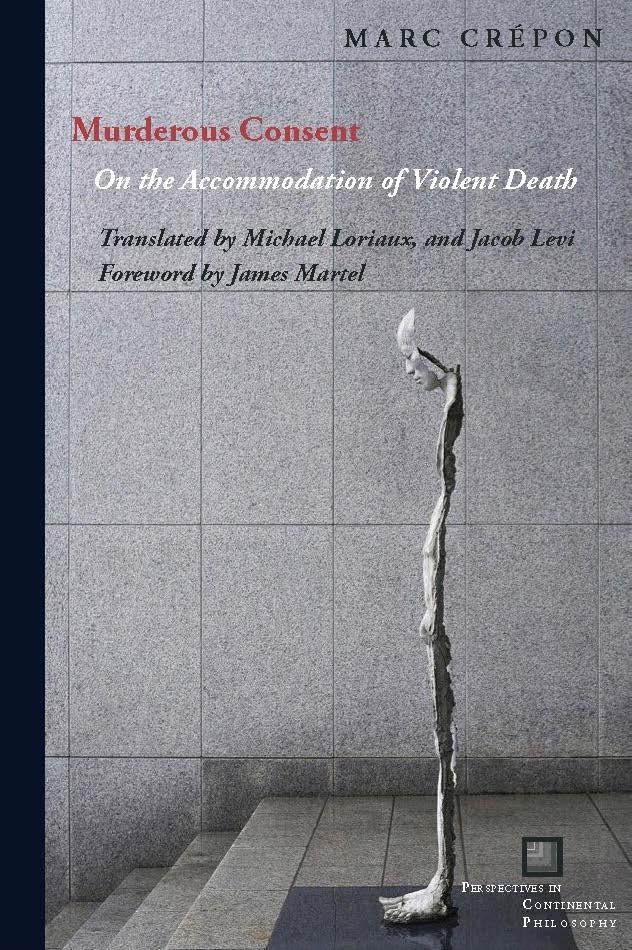
Murderous Consent details our implication in violence we do not directly inflict but in which we are structurally complicit: famines, civil wars, political repression in far-away places, and war, as it’s classically understood. Marc Crépon insists on a bond between ethics and politics and attributes violence to our treatment of the two as separate spheres. We repeatedly resist the call to responsibility, as expressed by the appeal—by peoples across the world—for the care and attention that their vulnerability enjoins.
But Crépon argues that this resistance is not ineluctable, and the book searches for ways that enable us to mitigate it, through rebellion, kindness, irony, critique, and shame. In the process, he engages with a range of writers, from Camus, Sartre, and Freud, to Stefan Zweig and Karl Kraus, to Kenzaburo Oe, Emmanuel Levinas and Judith Butler. The resulting exchange between philosophy and literature enables Crépon to delineate the contours of a possible/impossible ethicosmopolitics—an ethicosmopolitics to come.
Pushing against the limits of liberal rationalism, Crépon calls for a more radical understanding of interpersonal responsibility. Not just a work of philosophy but an engagement with life as it’s lived, Murderous Consent works to redefine our global obligations, articulating anew what humanitarianism demands and what an ethically grounded political resistance might mean.
Betal enkelt med kort, Klarna, Apple Pay eller Google Pay. Ikke fornøyd? Du har alltid 14 dagers angrerett. Les mer i våre vilkår. Har du spørsmål, send oss en e-post på hello@memmo.org.
Memmo gjør det enklere å studere – uansett hvor du er i verden. Hos oss samler du pensumbøker og smarte studieverktøy på ett og samme sted: sammendrag, quizer, podkaster og flashcards. Og så Ted, din studiekompis som svarer på alt du lurer på. Over 50 000 studenter studerer allerede her – bygget for at du skal lære raskere og stresse mindre.