
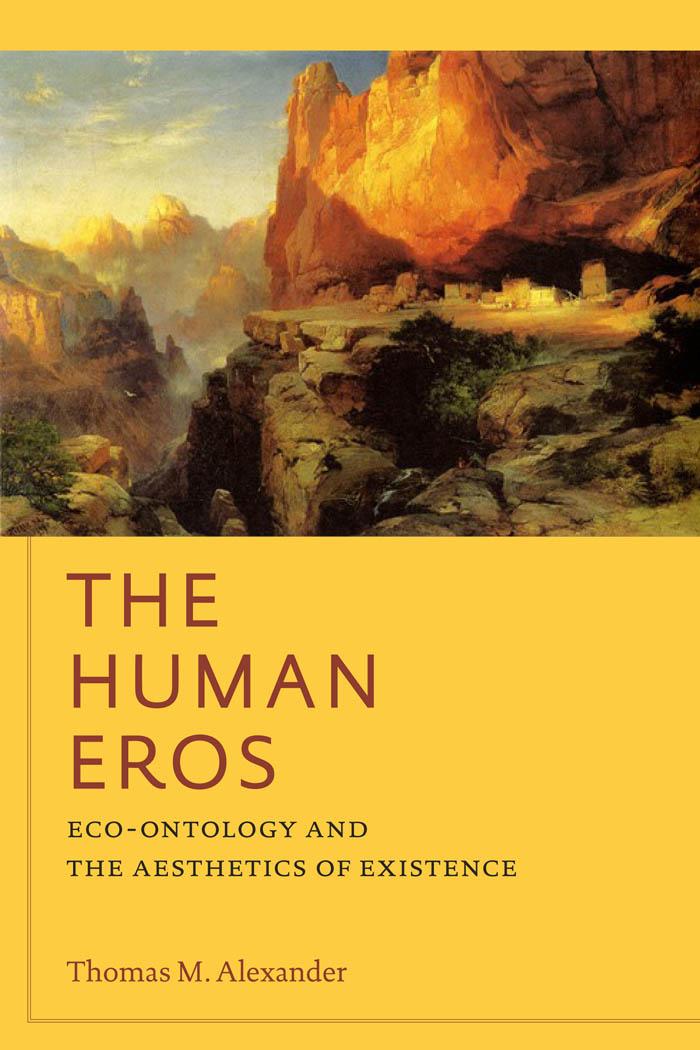
The Human Eros explores themes in classical American philosophy, primarily the thought of John Dewey, but also that of Ralph Waldo Emerson, George Santayana, and Native American traditions. Alexander’s primary claim is that human beings have an inherent need to experience meaning and value, a “Human Eros.” Our
various cultures are symbolic environments or “spiritual ecologies” within which the Human Eros seeks to thrive. This is how we inhabit the earth.
Encircling and sustaining our cultural existence is nature, yet Western philosophy has not provided adequate conceptual models for thinking ecologically. Alexander introduces the idea of “eco-ontology” to explore ways in which this might be done, beginning with the primacy of Nature over Being but also including the recognition of possibility and potentiality as inherent aspects of existence. He argues for the centrality of Dewey’s thought to an effective ecological philosophy. Both “pragmatism” and “naturalism,” he shows, need to be contextualized within an emergentist, relational, nonreductive view of nature and an aesthetic, imaginative, nonreductive view of intelligence.
Betal enkelt med kort, Klarna, Apple Pay eller Google Pay. Ikke fornøyd? Du har alltid 14 dagers angrerett. Les mer i våre vilkår. Har du spørsmål, send oss en e-post på hello@memmo.org.
Memmo gjør det enklere å studere – uansett hvor du er i verden. Hos oss samler du pensumbøker og smarte studieverktøy på ett og samme sted: sammendrag, quizer, podkaster og flashcards. Og så Ted, din studiekompis som svarer på alt du lurer på. Over 50 000 studenter studerer allerede her – bygget for at du skal lære raskere og stresse mindre.