
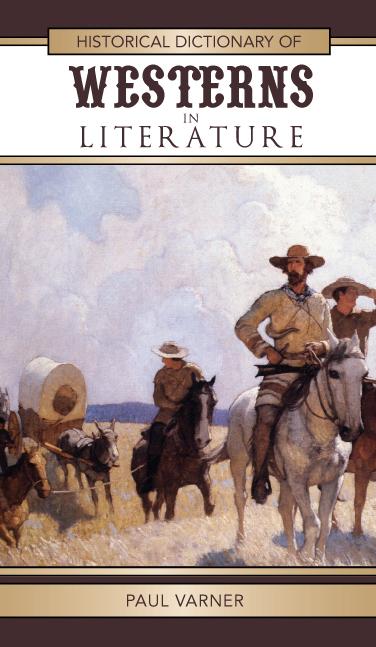
When in 1902 Owen Wister, a member of the Eastern blueblood aristocracy and friend of novelist Henry James, became a best-selling novelist with the publication of The Virginian, few readers would have guessed that a new kind of American literature was being born. While Owen Wister was enjoying his success, Edwin S. Porter in New Jersey was filming the first cinema Western The Great Train Robbery, which would usher in a new era both of movies in general and of Western movies in particular. Both events would lead to a century of cultural fascination with stories of the old West.
The Historical Dictionary of Westerns in Literature tells the story of the Western through a chronology, a bibliography, an introductory essay, and hundreds of cross-referenced dictionary entries on authors such as Owen Wister, Zane Grey, Max Brand, Clarence Mulford, Ernest Haycox, Luke Short, Dorothy Johnson, Louis L'Amour, and Cormac McCarthy.
The Historical Dictionary of Westerns in Literature tells the story of the Western through a chronology, a bibliography, an introductory essay, and hundreds of cross-referenced dictionary entries on authors such as Owen Wister, Zane Grey, Max Brand, Clarence Mulford, Ernest Haycox, Luke Short, Dorothy Johnson, Louis L'Amour, and Cormac McCarthy.
Betal enkelt med kort, Klarna, Apple Pay eller Google Pay. Ikke fornøyd? Du har alltid 14 dagers angrerett. Les mer i våre vilkår. Har du spørsmål, send oss en e-post på hello@memmo.org.
Memmo gjør det enklere å studere – uansett hvor du er i verden. Hos oss samler du pensumbøker og smarte studieverktøy på ett og samme sted: sammendrag, quizer, podkaster og flashcards. Og så Ted, din studiekompis som svarer på alt du lurer på. Over 50 000 studenter studerer allerede her – bygget for at du skal lære raskere og stresse mindre.