
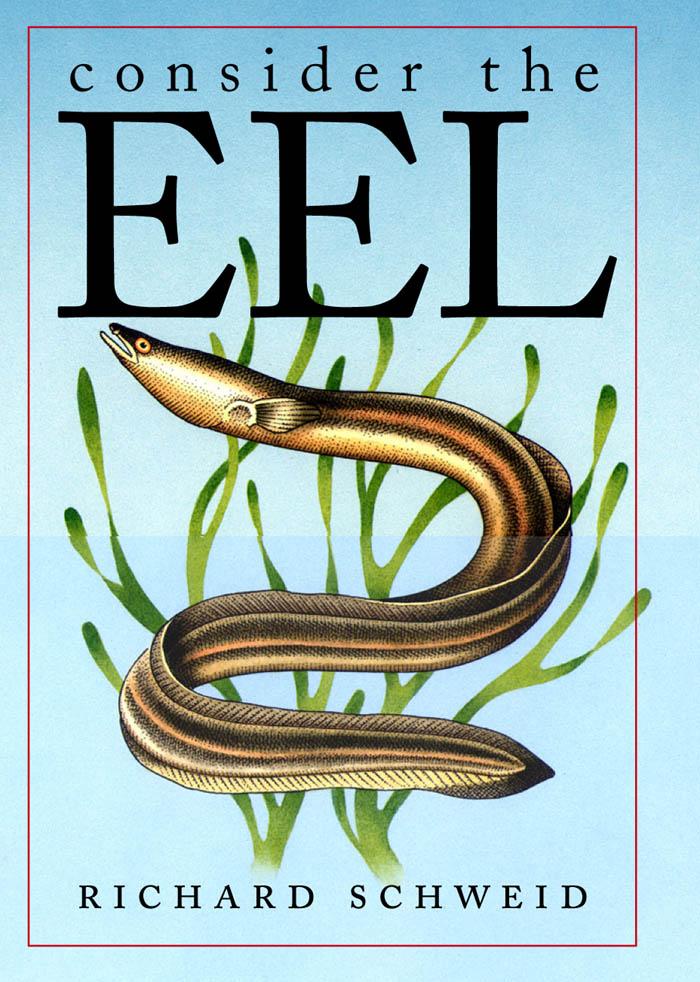
Journalist Richard Schweid first learned the strange facts of the freshwater eel’s life from a fisherman in a small Spanish town just south of Valencia. “The eeler who explained the animal’s life cycle to me did so as he served up an eel he had just taken from a trap, killed, cleaned, and cooked in olive oil in an earthenware dish,” writes Schweid. “I ate it with a chunk of fresh, crusty bread. It was delicious. I was immediately fascinated.”
As this engaging culinary and natural history reveals, the humble eel is indeed an amazing creature. Every European and American eel begins its life in the Sargasso Sea — a vast, weedy stretch of deep Atlantic waters between Bermuda and the Azores. Larval eels drift for up to three years until they reach the rivers of North America or Europe, where they mature and live as long as two decades before returning to the Sargasso to mate and die. Eels have never been bred successfully in captivity.
Consulting fisherfolk, cooks, and scientists, Schweid takes the reader on a global tour to reveal the economic and gastronomic importance of eel in places such as eastern North Carolina, Spain, Northern Ireland, England, and Japan. (While this rich yet mild-tasting fish has virtually disappeared from U.S. tables, over $2 billion worth of eel is still eagerly consumed in Europe and Asia each year.) The book also includes recipes, both historic and contemporary, for preparing eel.
As this engaging culinary and natural history reveals, the humble eel is indeed an amazing creature. Every European and American eel begins its life in the Sargasso Sea — a vast, weedy stretch of deep Atlantic waters between Bermuda and the Azores. Larval eels drift for up to three years until they reach the rivers of North America or Europe, where they mature and live as long as two decades before returning to the Sargasso to mate and die. Eels have never been bred successfully in captivity.
Consulting fisherfolk, cooks, and scientists, Schweid takes the reader on a global tour to reveal the economic and gastronomic importance of eel in places such as eastern North Carolina, Spain, Northern Ireland, England, and Japan. (While this rich yet mild-tasting fish has virtually disappeared from U.S. tables, over $2 billion worth of eel is still eagerly consumed in Europe and Asia each year.) The book also includes recipes, both historic and contemporary, for preparing eel.
Betal enkelt med kort, Klarna, Apple Pay eller Google Pay. Ikke fornøyd? Du har alltid 14 dagers angrerett. Les mer i våre vilkår. Har du spørsmål, send oss en e-post på hello@memmo.org.
Memmo gjør det enklere å studere – uansett hvor du er i verden. Hos oss samler du pensumbøker og smarte studieverktøy på ett og samme sted: sammendrag, quizer, podkaster og flashcards. Og så Ted, din studiekompis som svarer på alt du lurer på. Over 50 000 studenter studerer allerede her – bygget for at du skal lære raskere og stresse mindre.
Du vil kanskje også like
Kjøp boken0