
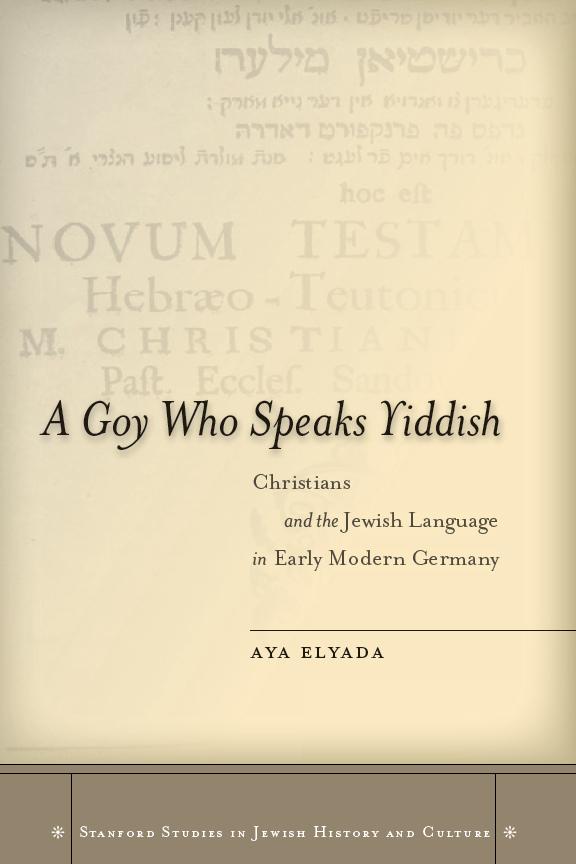
This book explores the unique phenomenon of Christian engagement with Yiddish language and literature from the beginning of the sixteenth century to the late eighteenth century. By exploring the motivations for Christian interest in Yiddish, and the differing ways in which Yiddish was discussed and treated in Christian texts, A Goy Who Speaks Yiddish addresses a wide array of issues, most notably Christian Hebraism, Protestant theology, early modern Yiddish culture, and the social and cultural history of language in early modern Europe.
Elyada's analysis of a wide range of philological and theological works, as well as textbooks, dictionaries, ethnographical writings, and translations, demonstrates that Christian Yiddishism had implications beyond its purely linguistic and philological dimensions. Indeed, Christian texts on Yiddish reveal not only the ways in which Christians perceived and defined Jews and Judaism, but also, in a contrasting vein, how they viewed their own language, religion, and culture.
Betal enkelt med kort, Klarna, Apple Pay eller Google Pay. Ikke fornøyd? Du har alltid 14 dagers angrerett. Les mer i våre vilkår. Har du spørsmål, send oss en e-post på hello@memmo.org.
Memmo gjør det enklere å studere – uansett hvor du er i verden. Hos oss samler du pensumbøker og smarte studieverktøy på ett og samme sted: sammendrag, quizer, podkaster og flashcards. Og så Ted, din studiekompis som svarer på alt du lurer på. Over 50 000 studenter studerer allerede her – bygget for at du skal lære raskere og stresse mindre.