
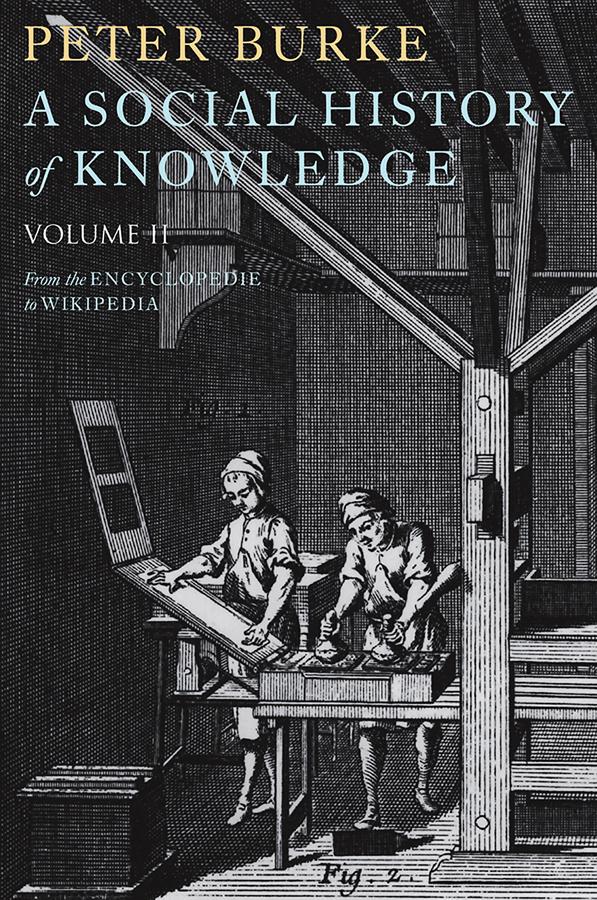
Peter Burke follows up his magisterial Social History of Knowledge, picking up where the first volume left off around 1750 at the publication of the French Encyclopédie and following the story through to Wikipedia. Like the previous volume, it offers a social history (or a retrospective sociology of knowledge) in the sense that it focuses not on individuals but on groups, institutions, collective practices and general trends.
The book is divided into 3 parts. The first argues that activities which appear to be timeless - gathering knowledge, analysing, disseminating and employing it - are in fact time-bound and take different forms in different periods and places. The second part tries to counter the tendency to write a triumphalist history of the 'growth' of knowledge by discussing losses of knowledge and the price of specialization. The third part offers geographical, sociological and chronological overviews, contrasting the experience of centres and peripheries and arguing that each of the main trends of the period - professionalization, secularization, nationalization, democratization, etc, coexisted and interacted with its opposite.
As ever, Peter Burke presents a breath-taking range of scholarship in prose of exemplary clarity and accessibility. This highly anticipated second volume will be essential reading across the humanities and social sciences.
Betal enkelt med kort, Klarna, Apple Pay eller Google Pay. Ikke fornøyd? Du har alltid 14 dagers angrerett. Les mer i våre vilkår. Har du spørsmål, send oss en e-post på hello@memmo.org.
Memmo gjør det enklere å studere – uansett hvor du er i verden. Hos oss samler du pensumbøker og smarte studieverktøy på ett og samme sted: sammendrag, quizer, podkaster og flashcards. Og så Ted, din studiekompis som svarer på alt du lurer på. Over 50 000 studenter studerer allerede her – bygget for at du skal lære raskere og stresse mindre.