
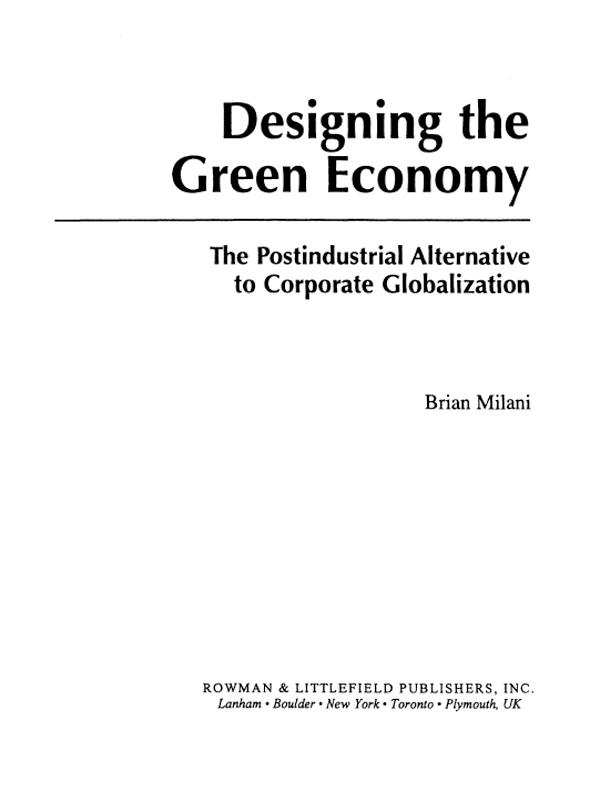
Designing the Green Economy explores realistically, and in detail, the world's enormous potential for human and ecological regeneration. It also explains why this potential has been suppressed or distorted by industrial institutions-thus creating economic crisis, growing inequality, and environmental destruction. The first half of the book looks at the challenge ecological change has represented to capitalism, as well as capitalism's repressive response: the waste economy, as expressed in postwar Fordist capitalism and current trends toward a globalized economy. But today “the great divide” between waste and green economies can be narrowed by emerging legal, institutional, and market approaches to production and environmentalism. In Part II, Milani explores the practical and theoretical implications of fully unleashing these new productive forces to create community-based ecological economies. Milani argues that neither sustainability, social justice nor economic stability can be secured without comprehensive redesign of the economy along ecological principles. It looks at key sectors of the economy-including manufacturing, energy, and money and finance-to illustrate how this redesign can, and is, taking place through both incremental grassroots initiatives and transformative politics.
Betal enkelt med kort, Klarna, Apple Pay eller Google Pay. Ikke fornøyd? Du har alltid 14 dagers angrerett. Les mer i våre vilkår. Har du spørsmål, send oss en e-post på hello@memmo.org.
Memmo gjør det enklere å studere – uansett hvor du er i verden. Hos oss samler du pensumbøker og smarte studieverktøy på ett og samme sted: sammendrag, quizer, podkaster og flashcards. Og så Ted, din studiekompis som svarer på alt du lurer på. Over 50 000 studenter studerer allerede her – bygget for at du skal lære raskere og stresse mindre.