
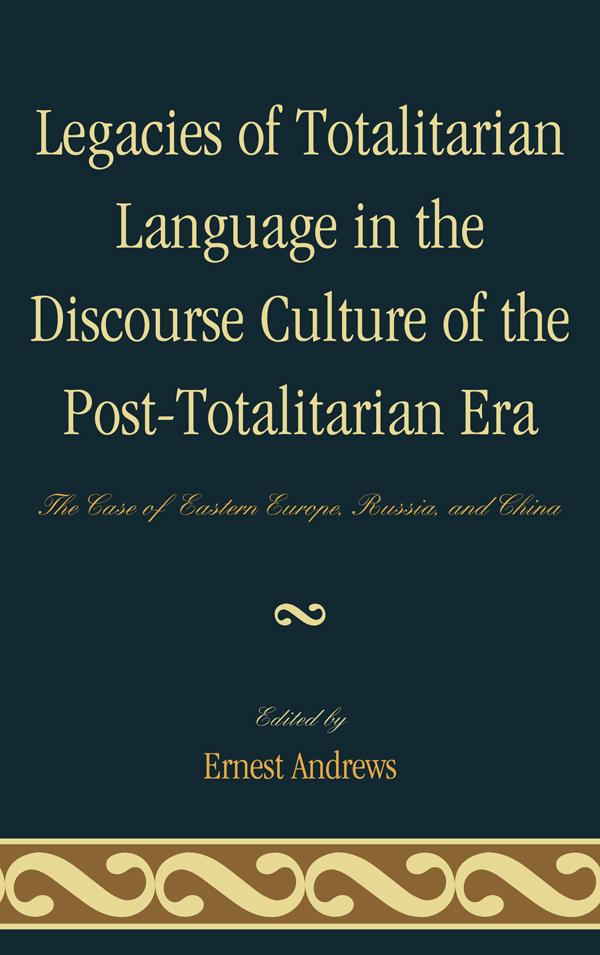
Legacies of Totalitarian Language in the Discourse Culture of the Post-Totalitarian Era
Forfatter: Andrejs Plakans, Magda Stroinska, Matthew H. Ciscel, Marius Dragomir, Fengyuan Ji, Ekaterina Levintova, Marek Skovajsa, Norina Solomon, Cosmina Tanasoiu, Rossen Vassilev, Ernest Andrews
Forlag: Bloomsbury Publishing
Utgave: 1
Utgivelsesår: 2011
ISBN: 9780739164655
This book is unique in its kind. It is the first scholarly work to attempt a comprehensive and fairly detailed look into the lingering legacies of the communist totalitarian modes of thought and expression in the new discourse forms of the post-totalitarian era. The book gives also new and interesting insights into the ways the new, presumably democratically-minded political elites in post-totalitarian Eastern Europe, Russia, and China manipulate language to serve their own political and economic agendas. The book consists of ten discrete discussions, nine case-studies or chapters and an introduction.
Chapter 1 discusses patterns of continuity and change in the conceptual apparatus and linguistic habits of political science and sociology practiced in the Czech Republic before and after 1989. Chapter 2 analyzes lingering effects of communist propaganda language in the political discourse and behavior in post-communist Poland. Chapter 3 analyzes the legacy of Soviet semantics in post-Soviet Moldovan politics through the prism of such politically contested words as "democracy," "democratization," and "people." Chapters 4 and 5 discuss the way in which communist patterns of thought and expression manifest themselves in the new political discourse in Romania and Bulgaria, respectively. Chapter 6 examines phenomena of change and continuity in the socio-linguistic and socio-political scene of post-Soviet Latvia. Chapter 7 analyzes the extent to which the language of the post-communist Romanian media differs from the official language of the communist era. Chapter 8 examines the evolution of Russian official discourse since the late eighties with a view of showing "whether or not new phenomena in the evolution of post-Soviet discourse represent new development or just a mutation of the value-orientations of the old Soviet ideological apparatus." Chapter 9 gives a detailed and lucid account of the evolution of both official and non-official discourse in China since the end of the Mao era.
Chapter 1 discusses patterns of continuity and change in the conceptual apparatus and linguistic habits of political science and sociology practiced in the Czech Republic before and after 1989. Chapter 2 analyzes lingering effects of communist propaganda language in the political discourse and behavior in post-communist Poland. Chapter 3 analyzes the legacy of Soviet semantics in post-Soviet Moldovan politics through the prism of such politically contested words as "democracy," "democratization," and "people." Chapters 4 and 5 discuss the way in which communist patterns of thought and expression manifest themselves in the new political discourse in Romania and Bulgaria, respectively. Chapter 6 examines phenomena of change and continuity in the socio-linguistic and socio-political scene of post-Soviet Latvia. Chapter 7 analyzes the extent to which the language of the post-communist Romanian media differs from the official language of the communist era. Chapter 8 examines the evolution of Russian official discourse since the late eighties with a view of showing "whether or not new phenomena in the evolution of post-Soviet discourse represent new development or just a mutation of the value-orientations of the old Soviet ideological apparatus." Chapter 9 gives a detailed and lucid account of the evolution of both official and non-official discourse in China since the end of the Mao era.
Betal enkelt med kort, Klarna, Apple Pay eller Google Pay. Ikke fornøyd? Du har alltid 14 dagers angrerett. Les mer i våre vilkår. Har du spørsmål, send oss en e-post på hello@memmo.org.
Memmo gjør det enklere å studere – uansett hvor du er i verden. Hos oss samler du pensumbøker og smarte studieverktøy på ett og samme sted: sammendrag, quizer, podkaster og flashcards. Og så Ted, din studiekompis som svarer på alt du lurer på. Over 50 000 studenter studerer allerede her – bygget for at du skal lære raskere og stresse mindre.