
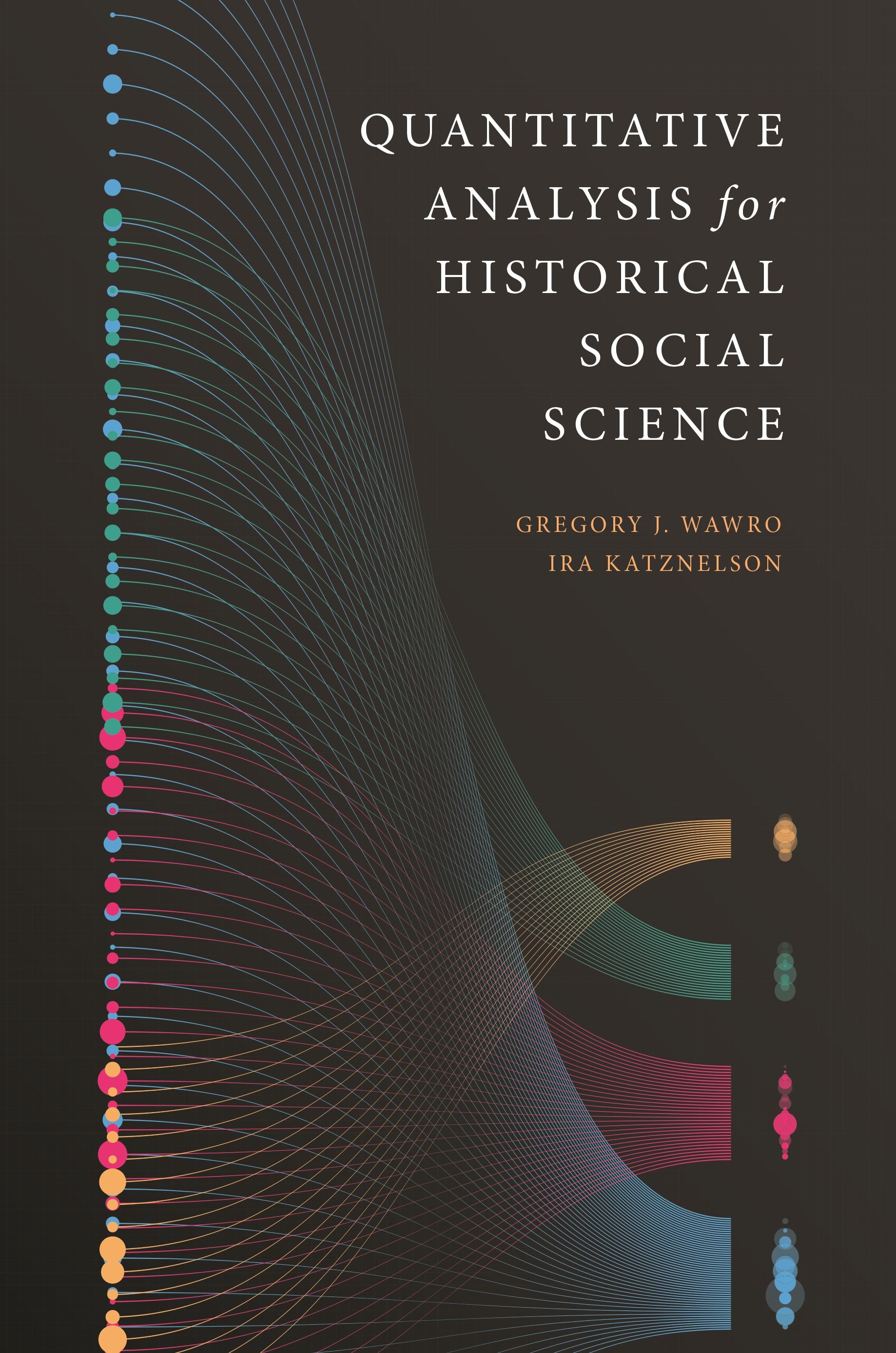
How to study the past using data
Quantitative Analysis for Historical Social Science advances historical research in the social sciences by bridging the divide between qualitative and quantitative analysis. Gregory Wawro and Ira Katznelson argue for an expansion of the standard quantitative methodological toolkit with a set of innovative approaches that better capture nuances missed by more commonly used statistical methods. Demonstrating how to employ such promising tools, Wawro and Katznelson address the criticisms made by prominent historians and historically oriented social scientists regarding the shortcomings of mainstream quantitative approaches for studying the past.
Traditional statistical methods have been inadequate in addressing temporality, periodicity, specificity, and context—features central to good historical analysis. To address these shortcomings, Wawro and Katznelson argue for the application of alternative approaches that are particularly well-suited to incorporating these features in empirical investigations. The authors demonstrate the advantages of these techniques with replications of research that locate structural breaks and uncover temporal evolution. They develop new practices for testing claims about path dependence in time-series data, and they discuss the promise and perils of using historical approaches to enhance causal inference.
Opening a dialogue among traditional qualitative scholars and applied quantitative social scientists focusing on history, Quantitative Analysis for Historical Social Science illustrates powerful ways to move historical social science research forward.
Betal enkelt med kort, Klarna, Apple Pay eller Google Pay. Ikke fornøyd? Du har alltid 14 dagers angrerett. Les mer i våre vilkår. Har du spørsmål, send oss en e-post på hello@memmo.org.
Memmo gjør det enklere å studere – uansett hvor du er i verden. Hos oss samler du pensumbøker og smarte studieverktøy på ett og samme sted: sammendrag, quizer, podkaster og flashcards. Og så Ted, din studiekompis som svarer på alt du lurer på. Over 50 000 studenter studerer allerede her – bygget for at du skal lære raskere og stresse mindre.