
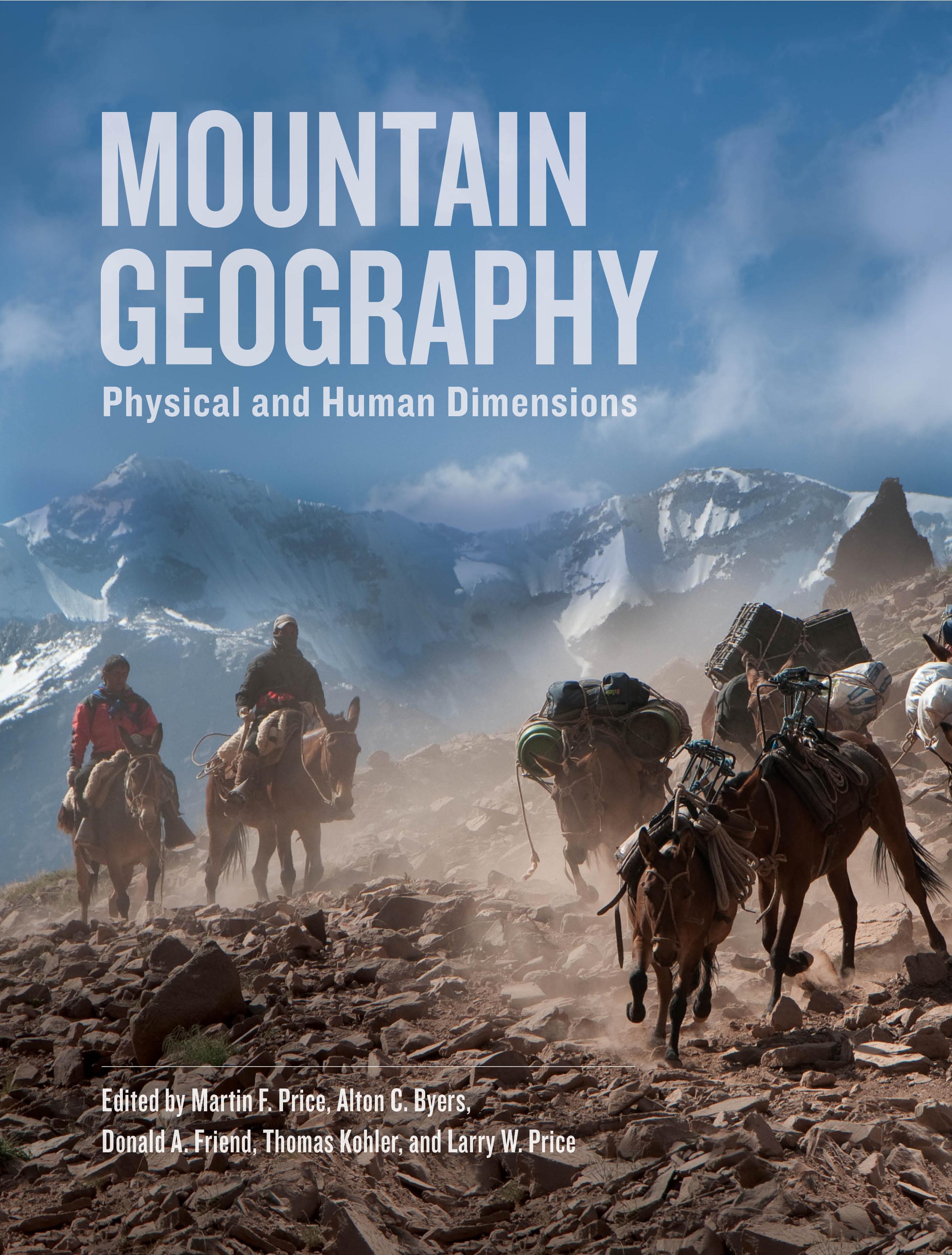
Mountains cover a quarter of the Earth’s land surface and a quarter of the global population lives in or adjacent to these areas. The global importance of mountains is recognized particularly because they provide critical resources, such as water, food and wood; contain high levels of biological and cultural diversity; and are often places for tourism and recreation and/or of sacred significance.
This major revision of Larry Price’s book Mountains and Man (1981) is both timely and highly appropriate. The past three decades have been a period of remarkable progress in our understanding of mountains from an academic point of view. Of even greater importance is that society at large now realizes that mountains and the people who reside in them are not isolated from the mainstream of world affairs, but are vital if we are to achieve an environmentally sustainable future.
Mountain Geography is a comprehensive resource that gives readers an in-depth understanding of the geographical processes occurring in the world’s mountains and the overall impact of these regions on culture and society as a whole. The volume begins with an introduction to how mountains are defined, followed by a comprehensive treatment of their physical geography: origins, climatology, snow and ice, landforms and geomorphic processes, soils, vegetation, and wildlife. The concluding chapters provide an introduction to the human geography of mountains: attitudes toward mountains, people living in mountain regions and their livelihoods and interactions within dynamic environments, the diverse types of mountain agriculture, and the challenges of sustainable mountain development.
This major revision of Larry Price’s book Mountains and Man (1981) is both timely and highly appropriate. The past three decades have been a period of remarkable progress in our understanding of mountains from an academic point of view. Of even greater importance is that society at large now realizes that mountains and the people who reside in them are not isolated from the mainstream of world affairs, but are vital if we are to achieve an environmentally sustainable future.
Mountain Geography is a comprehensive resource that gives readers an in-depth understanding of the geographical processes occurring in the world’s mountains and the overall impact of these regions on culture and society as a whole. The volume begins with an introduction to how mountains are defined, followed by a comprehensive treatment of their physical geography: origins, climatology, snow and ice, landforms and geomorphic processes, soils, vegetation, and wildlife. The concluding chapters provide an introduction to the human geography of mountains: attitudes toward mountains, people living in mountain regions and their livelihoods and interactions within dynamic environments, the diverse types of mountain agriculture, and the challenges of sustainable mountain development.
Betal enkelt med kort, Klarna, Apple Pay eller Google Pay. Ikke fornøyd? Du har alltid 14 dagers angrerett. Les mer i våre vilkår. Har du spørsmål, send oss en e-post på hello@memmo.org.
Memmo gjør det enklere å studere – uansett hvor du er i verden. Hos oss samler du pensumbøker og smarte studieverktøy på ett og samme sted: sammendrag, quizer, podkaster og flashcards. Og så Ted, din studiekompis som svarer på alt du lurer på. Over 50 000 studenter studerer allerede her – bygget for at du skal lære raskere og stresse mindre.
Du vil kanskje også like
Kjøp boken0