
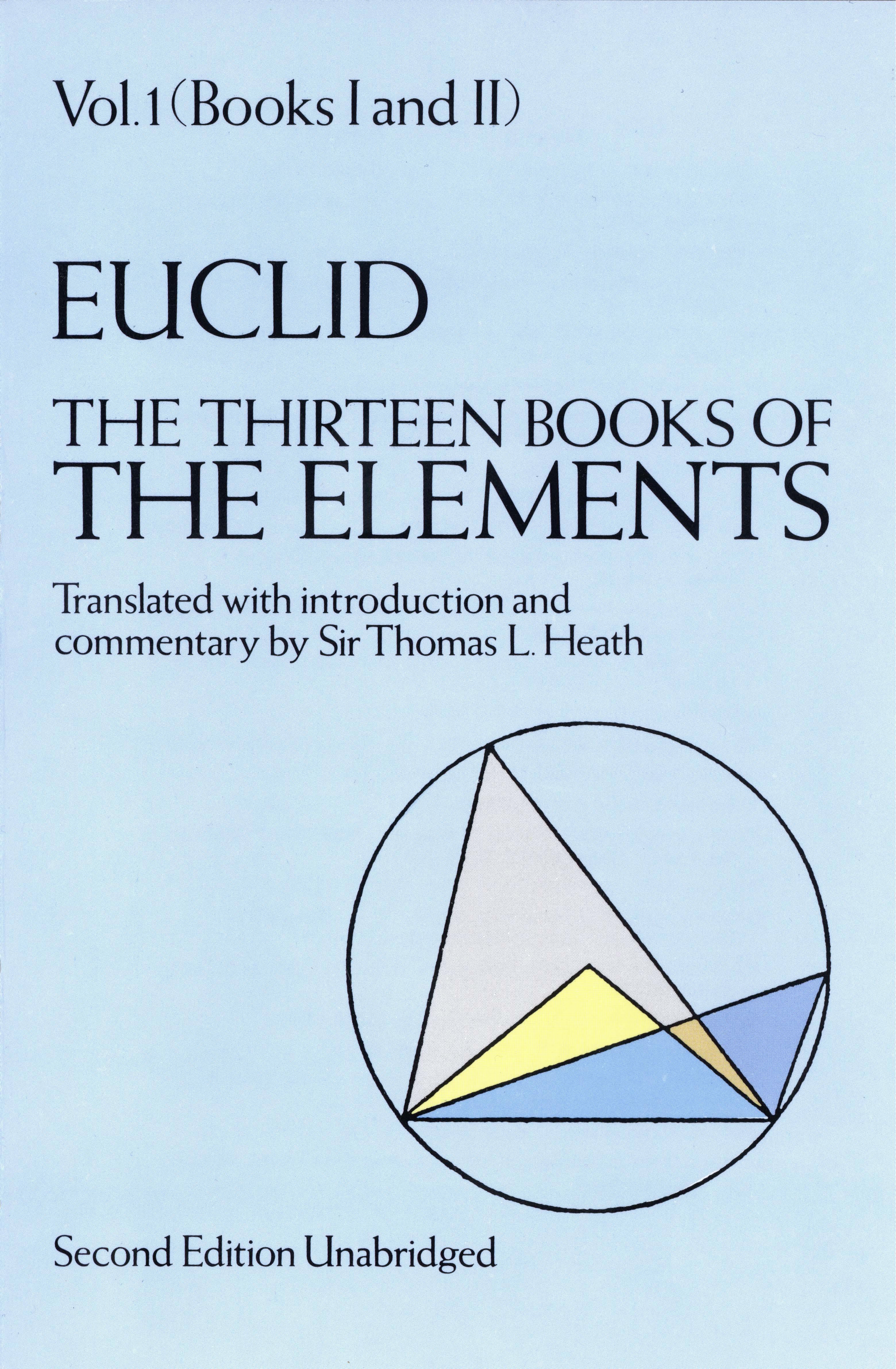
This is the definitive edition of one of the very greatest classics of all time — the full Euclid, not an abridgement. Using the text established by Heiberg, Sir Thomas Heath encompasses almost 2,500 years of mathematical and historical study upon Euclid.
This unabridged republication of the original enlarged edition contains the complete English text of all 13 books of the Elements, plus a critical apparatus that analyzes each definition, postulate, and proposition in great detail. It covers textual and linguistic matters; mathematical analyses of Euclid’s ideas; classical, medieval, Renaissance, modern commentators; refutations, supports, extrapolations, reinterpretations, and historical notes, all given with extensive quotes.
“The textbook that shall really replace Euclid has not yet been written and probably never will be.” — Encyclopaedia Britannica.
Volume 1. 151-page Introduction: life and other works of Euclid; Greek and Islamic commentators; surviving mss., scholia, translations; bases of Euclid’s thought. Books I and II of the Elements, straight lines, angles, intersection of lines, triangles, parallelograms, etc.
Volume 2. Books III-IX: Circles, tangents, segments, figures described around and within circles, rations, proportions, magnitudes, polygons, prime numbers, products, plane and solid numbers, series of rations, etc.
Volume 3. Books X to XIII: planes, solid angles, etc.; method of exhaustion in similar polygons within circles, pyramids, cones, cylinders, spheres, etc. Appendix: Books XIV, XV, sometimes ascribed to Euclid.
This unabridged republication of the original enlarged edition contains the complete English text of all 13 books of the Elements, plus a critical apparatus that analyzes each definition, postulate, and proposition in great detail. It covers textual and linguistic matters; mathematical analyses of Euclid’s ideas; classical, medieval, Renaissance, modern commentators; refutations, supports, extrapolations, reinterpretations, and historical notes, all given with extensive quotes.
“The textbook that shall really replace Euclid has not yet been written and probably never will be.” — Encyclopaedia Britannica.
Volume 1. 151-page Introduction: life and other works of Euclid; Greek and Islamic commentators; surviving mss., scholia, translations; bases of Euclid’s thought. Books I and II of the Elements, straight lines, angles, intersection of lines, triangles, parallelograms, etc.
Volume 2. Books III-IX: Circles, tangents, segments, figures described around and within circles, rations, proportions, magnitudes, polygons, prime numbers, products, plane and solid numbers, series of rations, etc.
Volume 3. Books X to XIII: planes, solid angles, etc.; method of exhaustion in similar polygons within circles, pyramids, cones, cylinders, spheres, etc. Appendix: Books XIV, XV, sometimes ascribed to Euclid.
Betal enkelt med kort, Klarna, Apple Pay eller Google Pay. Ikke fornøyd? Du har alltid 14 dagers angrerett. Les mer i våre vilkår. Har du spørsmål, send oss en e-post på hello@memmo.org.
Memmo gjør det enklere å studere – uansett hvor du er i verden. Hos oss samler du pensumbøker og smarte studieverktøy på ett og samme sted: sammendrag, quizer, podkaster og flashcards. Og så Ted, din studiekompis som svarer på alt du lurer på. Over 50 000 studenter studerer allerede her – bygget for at du skal lære raskere og stresse mindre.
Du vil kanskje også like
Kjøp boken0