
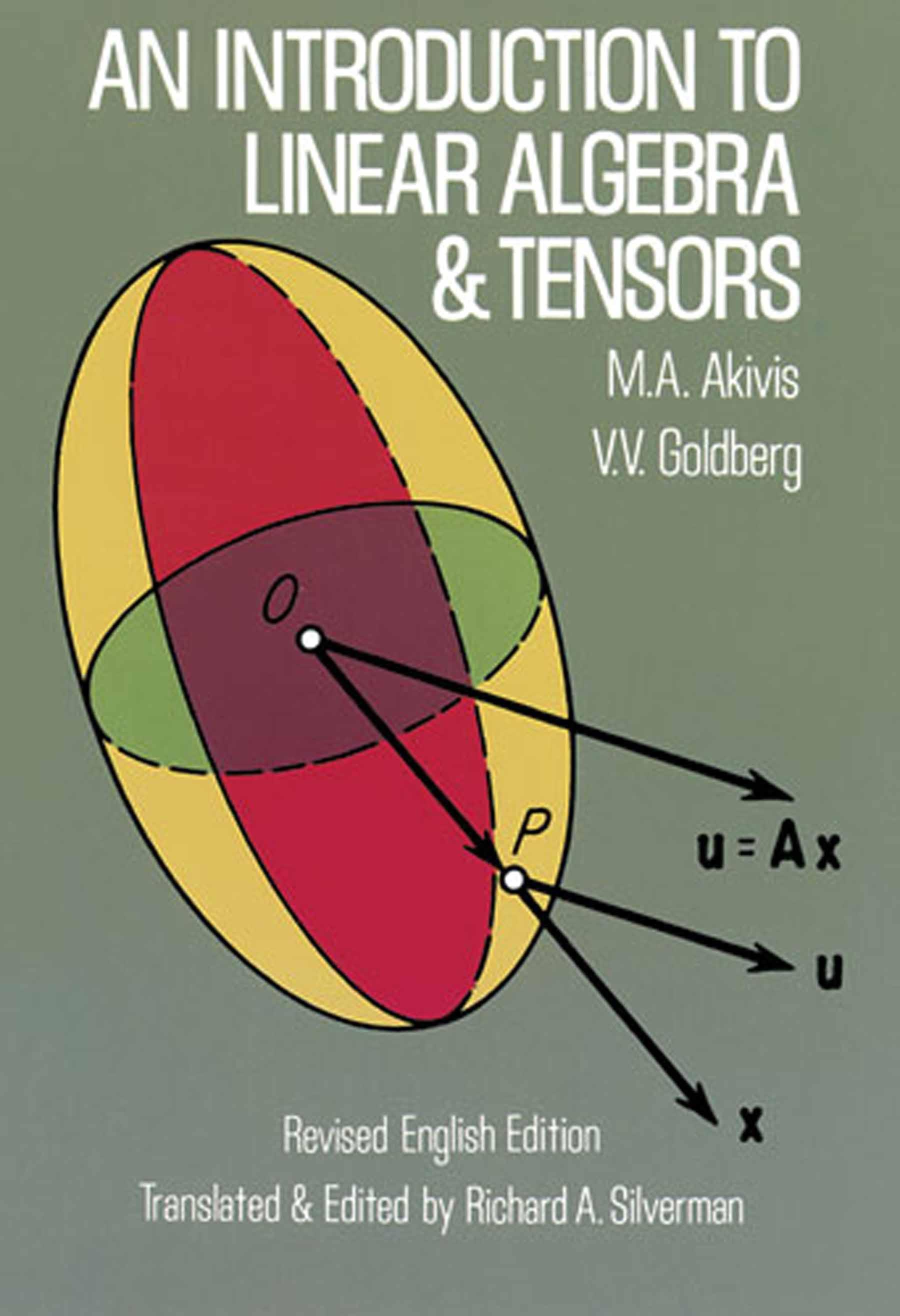
The present book, a valuable addition to the English-language literature on linear algebra and tensors, constitutes a lucid, eminently readable and completely elementary introduction to this field of mathematics. A special merit of the book is its free use of tensor notation, in particular the Einstein summation convention. The treatment is virtually self-contained. In fact, the mathematical background assumed on the part of the reader hardly exceeds a smattering of calculus and a casual acquaintance with determinants.
The authors begin with linear spaces, starting with basic concepts and ending with topics in analytic geometry. They then treat multilinear forms and tensors (linear and bilinear forms, general definition of a tensor, algebraic operations on tensors, symmetric and antisymmetric tensors, etc.), and linear transformation (again basic concepts, the matrix and multiplication of linear transformations, inverse transformations and matrices, groups and subgroups, etc.). The last chapter deals with further topics in the field: eigenvectors and eigenvalues, matrix ploynomials and the Hamilton-Cayley theorem, reduction of a quadratic form to canonical form, representation of a nonsingular transformation, and more. Each individual section — there are 25 in all — contains a problem set, making a total of over 250 problems, all carefully selected and matched. Hints and answers to most of the problems can be found at the end of the book.
Dr. Silverman has revised the text and numerous pedagogical and mathematical improvements, and restyled the language so that it is even more readable. With its clear exposition, many relevant and interesting problems, ample illustrations, index and bibliography, this book will be useful in the classroom or for self-study as an excellent introduction to the important subjects of linear algebra and tensors.
The authors begin with linear spaces, starting with basic concepts and ending with topics in analytic geometry. They then treat multilinear forms and tensors (linear and bilinear forms, general definition of a tensor, algebraic operations on tensors, symmetric and antisymmetric tensors, etc.), and linear transformation (again basic concepts, the matrix and multiplication of linear transformations, inverse transformations and matrices, groups and subgroups, etc.). The last chapter deals with further topics in the field: eigenvectors and eigenvalues, matrix ploynomials and the Hamilton-Cayley theorem, reduction of a quadratic form to canonical form, representation of a nonsingular transformation, and more. Each individual section — there are 25 in all — contains a problem set, making a total of over 250 problems, all carefully selected and matched. Hints and answers to most of the problems can be found at the end of the book.
Dr. Silverman has revised the text and numerous pedagogical and mathematical improvements, and restyled the language so that it is even more readable. With its clear exposition, many relevant and interesting problems, ample illustrations, index and bibliography, this book will be useful in the classroom or for self-study as an excellent introduction to the important subjects of linear algebra and tensors.
Betal enkelt med kort, Klarna, Apple Pay eller Google Pay. Ikke fornøyd? Du har alltid 14 dagers angrerett. Les mer i våre vilkår. Har du spørsmål, send oss en e-post på hello@memmo.org.
Memmo gjør det enklere å studere – uansett hvor du er i verden. Hos oss samler du pensumbøker og smarte studieverktøy på ett og samme sted: sammendrag, quizer, podkaster og flashcards. Og så Ted, din studiekompis som svarer på alt du lurer på. Over 50 000 studenter studerer allerede her – bygget for at du skal lære raskere og stresse mindre.
Du vil kanskje også like
Kjøp boken0