
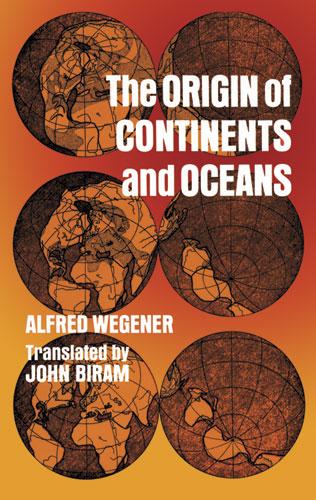
Since its inception modern geology has been faced with an important group of problems: explaining parallel formations that are separated by great distances of sea; accounting for isolated life forms in widely separated areas (such as lemurs in Madagascar and India); explaining pre-pleistocene glaciations, and similar problems. The usual explanation has been to assume the one-time existence of land bridges (such as the hypothetical Lemuria) or parallelisms or diffusion with lost intermediary steps.
In 1915, however, one of the most influential and most controversial books in the history of science provided a new solution. This was Alfred Wegener's Entstehung der Kontinente, which dispensed with land bridges and parallel evolutions and offered a more economical concept. Wegener proposed that in the remote past the earth's continents were not separate (as now), but formed one supercontinent which later split apart, the fragments gradually drifting away from one another. Wegener created his supercontinent with attractive simplicity by tucking the point of South America into the Gulf of Guinea, coalescing North America, Greenland, and Europe, rotating Australia and Antarctica up through the Indian Ocean, and closing the remaining gaps. Wegener then explained various phenomena in historical geology, geomorphy, paleontology, paleoclimatology, and similar areas of science in terms of this continental drift. To back up his revolutionary theory he drew upon a seemingly inexhaustible find of data. Later editions of his book added new data to refute his opponents or to strengthen his own views in the violent scientific quarrel that arose.
Even today this important question remains undecided, and geologists are divided into strongly opposed groups about the Wegener hypothesis. At the moment it seems to be gaining steadily in acceptance. It is one of the two basic theories of earth history, and since it has often been misrepresented in summary, every earth scientist owes it to himself to examine its theories and data.
Betal enkelt med kort, Klarna, Apple Pay eller Google Pay. Ikke fornøyd? Du har alltid 14 dagers angrerett. Les mer i våre vilkår. Har du spørsmål, send oss en e-post på hello@memmo.org.
Memmo gjør det enklere å studere – uansett hvor du er i verden. Hos oss samler du pensumbøker og smarte studieverktøy på ett og samme sted: sammendrag, quizer, podkaster og flashcards. Og så Ted, din studiekompis som svarer på alt du lurer på. Over 50 000 studenter studerer allerede her – bygget for at du skal lære raskere og stresse mindre.