
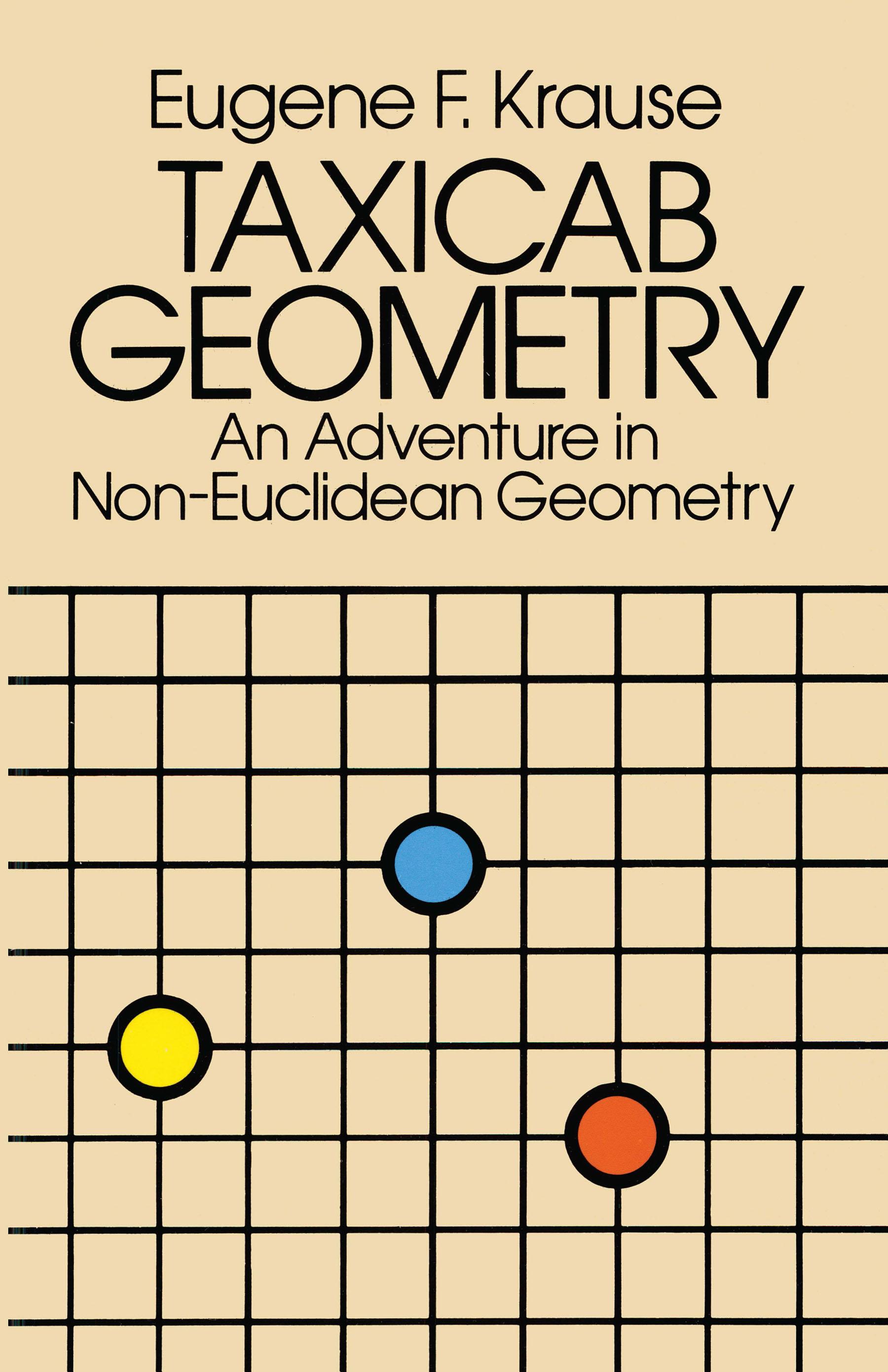
This entertaining, stimulating textbook offers anyone familiar with Euclidean geometry — undergraduate math students, advanced high school students, and puzzle fans of any age — an opportunity to explore taxicab geometry, a simple, non-Euclidean system that helps put Euclidean geometry in sharper perspective.
In taxicab geometry, the shortest distance between two points is not a straight line. Distance is not measured as the crow flies, but as a taxicab travels the "grid" of the city street, from block to block, vertically and horizontally, until the destination is reached. Because of this non-Euclidean method of measuring distance, some familiar geometric figures are transmitted: for example, circles become squares.
However, taxicab geometry has important practical applications. As Professor Krause points out, "While Euclidean geometry appears to be a good model of the 'natural' world, taxicab geometry is a better model of the artificial urban world that man has built."
As a result, the book is replete with practical applications of this non-Euclidean system to urban geometry and urban planning — from deciding the optimum location for a factory or a phone booth, to determining the most efficient routes for a mass transit system.
The underlying emphasis throughout this unique, challenging textbook is on how mathematicians think, and how they apply an apparently theoretical system to the solution of real-world problems.
Betal enkelt med kort, Klarna, Apple Pay eller Google Pay. Ikke fornøyd? Du har alltid 14 dagers angrerett. Les mer i våre vilkår. Har du spørsmål, send oss en e-post på hello@memmo.org.
Memmo gjør det enklere å studere – uansett hvor du er i verden. Hos oss samler du pensumbøker og smarte studieverktøy på ett og samme sted: sammendrag, quizer, podkaster og flashcards. Og så Ted, din studiekompis som svarer på alt du lurer på. Over 50 000 studenter studerer allerede her – bygget for at du skal lære raskere og stresse mindre.