
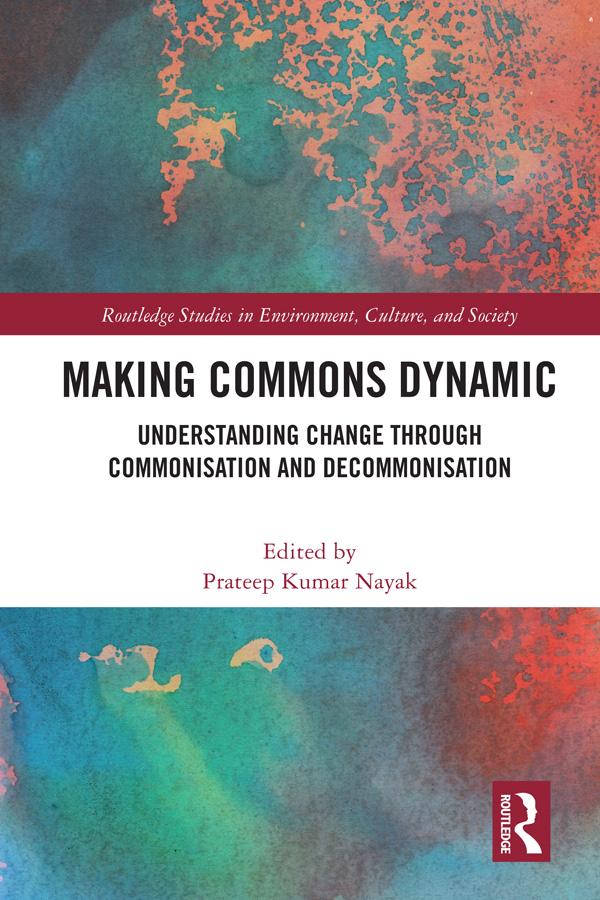
With an emphasis on the challenges of sustaining the commons across local to global scales, Making Commons Dynamic examines the empirical basis of theorising the concepts of commonisation and decommonisation as a way to understand commons as a process and offers analytical directions for policy and practice that can potentially help maintain commons as commons in the future.
Focusing on commonisation–decommonisation as an analytical framework useful to examine and respond to changes in the commons, the chapter contributions explore how natural resources are commonised and decommonised through the influence of multi-level internal and external drivers, and their implications for commons governance across disparate geographical and temporal contexts. It draws from a large number of geographically diverse empirical cases – 20 countries in North, South, and Central America and South- and South-East Asia. They involve a wide range of commons – related to fisheries, forests, grazing, wetlands, coastal-marine, rivers and dams, aquaculture, wildlife, tourism, groundwater, surface freshwater, mountains, small islands, social movements, and climate.
The book is a transdisciplinary endeavour with contributions by scholars from geography, history, sociology, anthropology, political studies, planning, human ecology, cultural and applied ecology, environmental and development studies, environmental science and technology, public policy, Indigenous/tribal studies, Latin American and Asian studies, and environmental change and governance, and authors representing the commons community, NGOs, and policy. Contributors include academics, community members, NGOs, practitioners, and policymakers. Therefore, commonisation–decommonisation lessons drawn from these chapters are well suited for contributing to the practice, policy, and theory of the commons, both locally and globally.
Betal enkelt med kort, Klarna, Apple Pay eller Google Pay. Ikke fornøyd? Du har alltid 14 dagers angrerett. Les mer i våre vilkår. Har du spørsmål, send oss en e-post på hello@memmo.org.
Memmo gjør det enklere å studere – uansett hvor du er i verden. Hos oss samler du pensumbøker og smarte studieverktøy på ett og samme sted: sammendrag, quizer, podkaster og flashcards. Og så Ted, din studiekompis som svarer på alt du lurer på. Over 50 000 studenter studerer allerede her – bygget for at du skal lære raskere og stresse mindre.