
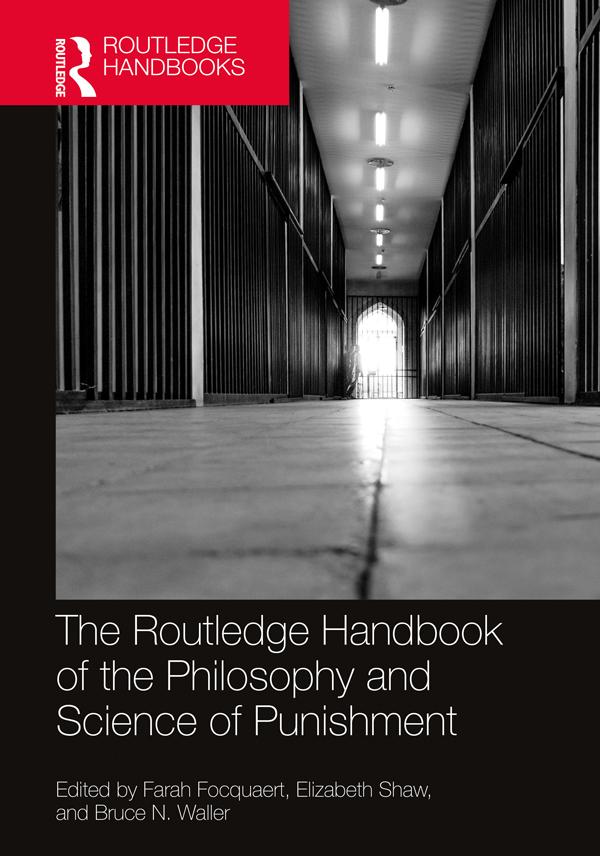
Philosophers, legal scholars, criminologists, psychiatrists, and psychologists have long asked important questions about punishment: What is its purpose? What theories help us better understand its nature? Is punishment just? Are there effective alternatives to punishment? How can empirical data from the sciences help us better understand punishment? What are the relationships between punishment and our biology, psychology, and social environment? How is punishment understood and administered differently in different societies? The Routledge Handbook of the Philosophy and Science of Punishment is the first major reference work to address these and other important questions in detail, offering 31 chapters from an international and interdisciplinary team of experts in a single, comprehensive volume. It covers the major theoretical approaches to punishment and its alternatives; emerging research from biology, psychology, and social neuroscience; and important special issues like the side-effects of punishment and solitary confinement, racism and stigmatization, the risk and protective factors for antisocial behavior, and victims' rights and needs.
The Handbook is conveniently organized into four sections:
I. Theories of Punishment and Contemporary Perspectives
II. Philosophical Perspectives on Punishment
III. Sciences, Prevention, and Punishment
IV. Alternatives to Current Punishment Practices
A volume introduction and a comprehensive index help make The Routledge Handbook of the Philosophy and Science of Punishment essential reading for upper-undergraduate and postgraduate students in disciplines such as philosophy, law, criminology, psychology, and forensic psychiatry, and highly relevant to a variety of other disciplines such as political and social sciences, behavioral and neurosciences, and global ethics. It is also an ideal resource for anyone interested in current theories, research, and programs dealing with the problem of punishment.
Betal enkelt med kort, Klarna, Apple Pay eller Google Pay. Ikke fornøyd? Du har alltid 14 dagers angrerett. Les mer i våre vilkår. Har du spørsmål, send oss en e-post på hello@memmo.org.
Memmo gjør det enklere å studere – uansett hvor du er i verden. Hos oss samler du pensumbøker og smarte studieverktøy på ett og samme sted: sammendrag, quizer, podkaster og flashcards. Og så Ted, din studiekompis som svarer på alt du lurer på. Over 50 000 studenter studerer allerede her – bygget for at du skal lære raskere og stresse mindre.